


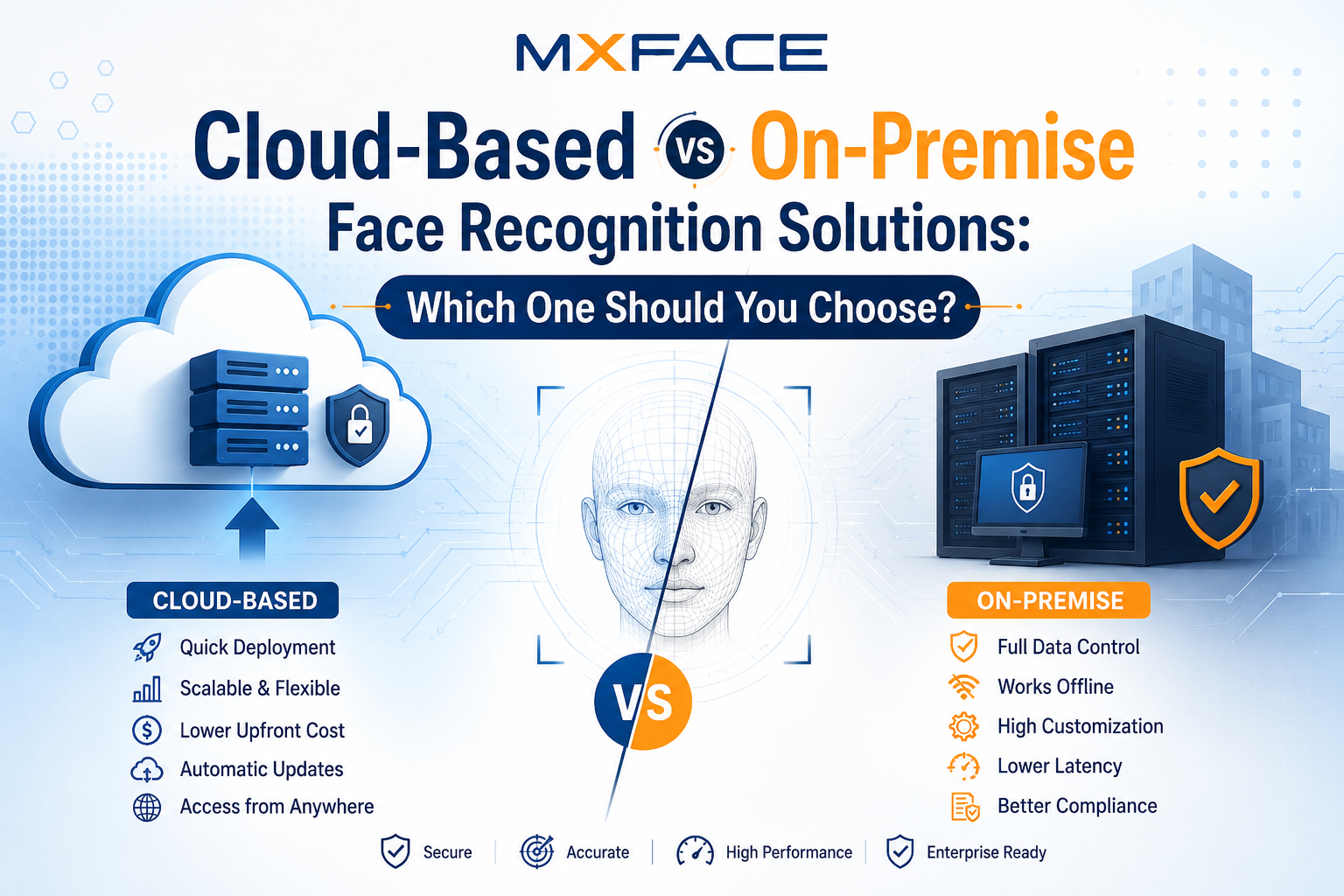
Cloud-Based vs On-Premise Face Recognition Solutions: Which One Should You Choose?
Face recognition technology has become a key component of modern identity verification, secure authentication, workforce management, and access control. As organizations increasingly adopt biometric solutions, one of the most important decisions they face is where the face recognition system should be deployed.
Should you choose a cloud-based face recognition solution, or is an on-premise face recognition system the better option?
Both deployment models deliver accurate face recognition capabilities, but they differ significantly in scalability, infrastructure, privacy, security, performance, and long-term cost. Understanding these differences will help you select the right architecture for your business.
In this guide, we'll compare cloud-based and on-premise face recognition solutions, explain their advantages and disadvantages, and help you determine which option best fits your organization.
What Is a Cloud-Based Face Recognition Solution?
A cloud-based face recognition solution processes facial images using remote servers managed by a service provider. Images or video frames are securely transmitted to the cloud, where artificial intelligence algorithms perform face detection, facial feature extraction, face matching, and, if supported, liveness detection.
The processed results are returned to your application through secure REST APIs or SDK integrations.
Since the provider manages the underlying infrastructure, businesses can integrate advanced biometric capabilities without investing in expensive hardware or AI expertise.
Advantages of Cloud-Based Face Recognition
- Requires internet connectivity
- Performance depends on network latency
- Less infrastructure control
- Organizations should review provider security and compliance practices
What Is an On-Premise Face Recognition Solution?
An on-premise face recognition solution runs entirely within your organization's own infrastructure. The recognition engine is installed on local servers, private cloud environments, or edge devices, allowing facial images to be processed without being transmitted to external cloud servers.
Organizations maintain complete ownership of the infrastructure, biometric database, and operational environment.
This deployment model is commonly chosen by organizations with strict privacy, security, or compliance requirements.
Advantages of On-Premise Face Recognition
- Higher initial infrastructure investment
- Requires IT maintenance
- Software updates must be managed internally
- Scalability depends on available hardware resources
Cloud-Based vs On-Premise Face Recognition Solutions
| Feature | ☁️ Cloud-Based | 🏢 On-Premise |
|---|---|---|
| Deployment | ✅ Provider Managed | ✅ Organization Managed |
| Initial Cost | 💲 Lower Upfront Cost | 💰 Higher Initial Investment |
| Maintenance | 🛠️ Handled by Provider | 👨💻 Managed Internally |
| Scalability | 📈 Easily Scalable | 🏗️ Depends on Infrastructure |
| Internet Required | 🌐 Yes | ❌ No |
| Offline Support | ❌ Not Available | ✅ Fully Supported |
| Processing Speed | ⚡ Depends on Network Latency | 🚀 Very Fast Local Processing |
| Data Control | 🔒 Shared Responsibility | 🛡️ Complete Organizational Control |
| Customization | ⚙️ Limited | 🎯 Highly Customizable |
| Disaster Recovery | ☁️ Managed by Provider | 🏢 Organization Responsible |
Performance Comparison
Performance is one of the biggest differences between cloud-based and on-premise face recognition systems.
Cloud-Based Processing
Every recognition request typically involves:
- Access control
- Attendance systems
- Airport checkpoints
- Manufacturing facilities
- Border security
- Smart surveillance
Privacy and Compliance
Biometric information is considered highly sensitive personal data. Protecting this information is essential regardless of the deployment model.
Cloud-Based Deployment
When using a cloud provider, organizations should understand:
- Data storage
- User access permissions
- Encryption policies
- Audit logs
- Backup procedures
- Data lifecycle management
This level of control is often preferred by organizations operating under strict regulatory or contractual requirements.
Cost Comparison
Cloud-Based Solutions
Cloud providers generally use usage-based pricing models, including:
- Servers
- GPU hardware
- Software licensing
- Maintenance
- IT personnel
- Infrastructure upgrades
While the initial investment is higher, organizations processing millions of recognition requests may benefit from predictable long-term operating costs.
Industries That Prefer Cloud-Based Face Recognition
- Government Agencies
- Defense Organizations
- Healthcare Providers
- Banking Institutions
- Manufacturing Plants
- Airports
- Border Control
- Critical Infrastructure
- Enterprise Access Control
These sectors often require offline operation, lower latency, enhanced customization, and greater control over biometric data.
Can You Combine Both Deployment Models?
Yes. Many enterprise organizations adopt a hybrid deployment model that combines the strengths of both approaches.
For example:
- Will users need access without an internet connection?
- Where should biometric data be processed and stored?
- What privacy and compliance requirements apply?
- How many recognition requests will the system process daily?
- Do you have an internal IT team to maintain infrastructure?
- Is rapid deployment more important than extensive customization?
- What is your long-term infrastructure budget?
The answers to these questions will help determine whether cloud-based, on-premise, or hybrid deployment best suits your organization's needs.
Final Thoughts
Both cloud-based and on-premise face recognition solutions provide powerful biometric authentication capabilities, but each is designed for different operational requirements.
A cloud-based face recognition solution is ideal for organizations seeking rapid deployment, lower upfront costs, simplified maintenance, and virtually unlimited scalability.
An on-premise face recognition solution is better suited for environments that require offline operation, real-time performance, greater customization, and complete control over biometric data.
Many organizations also benefit from a hybrid deployment strategy that combines local processing with centralized management, balancing performance, security, and scalability.
By carefully evaluating your business objectives, security requirements, compliance obligations, and long-term growth plans, you can select the face recognition deployment model that best supports your organization's digital identity strategy.


