


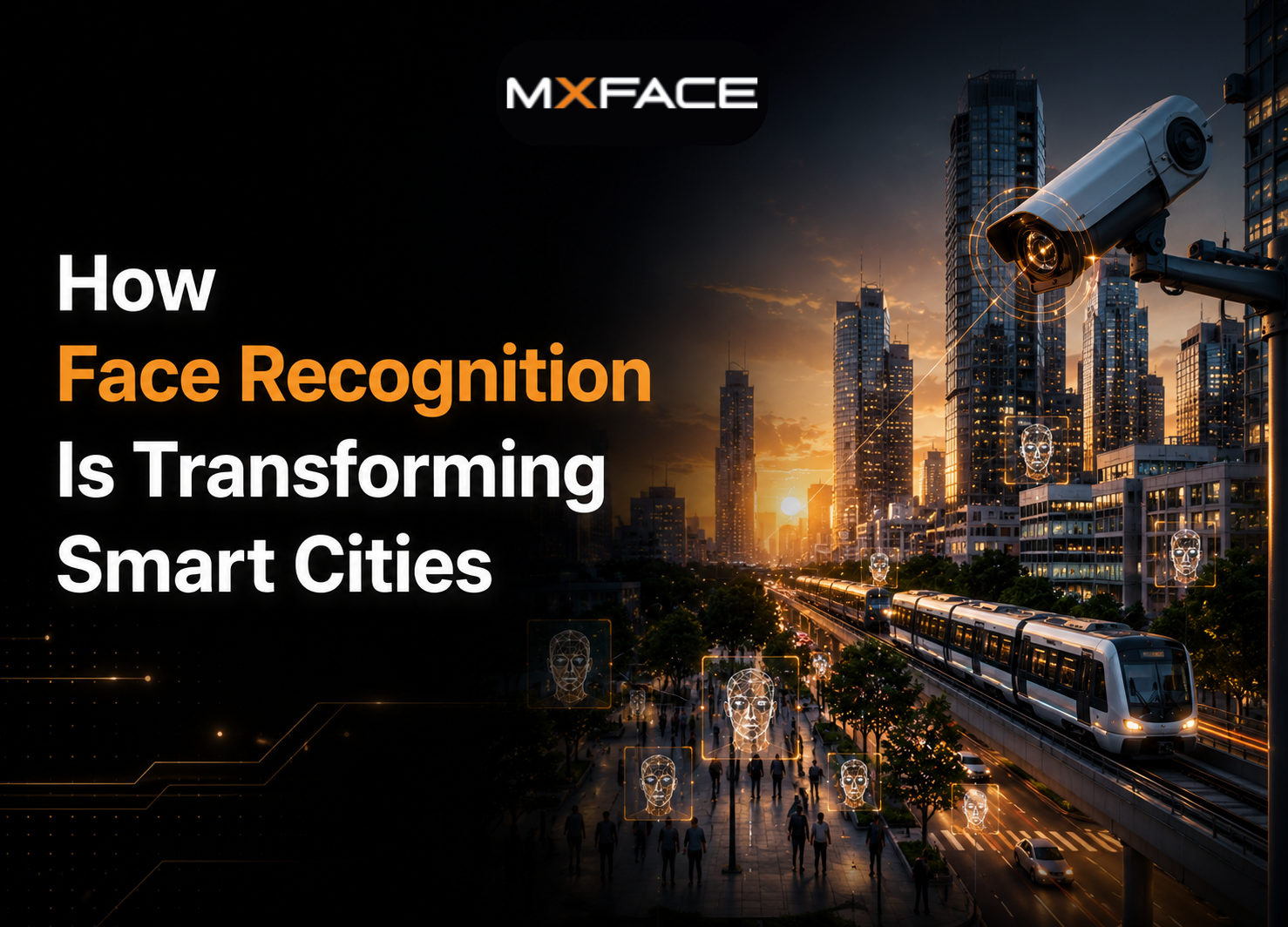
How Face Recognition Is Transforming Smart Cities: Building Safer, Smarter, and More Connected Urban Infrastructure
Imagine a city where transportation flows intelligently, public spaces remain secure, and citizens access services seamlessly all powered by AI-driven identity verification.
Cities around the world are evolving into intelligent ecosystems where technology is deeply integrated into everyday urban life. From smart traffic management and connected public transportation to digital citizen services and AI-powered surveillance, the vision of a smart city is no longer a concept of the future—it is becoming today's reality.
At the heart of this transformation is AI-powered face recognition, a technology that enables faster identity verification, improves public safety, and supports data-driven decision-making. Unlike traditional surveillance systems that rely heavily on manual monitoring, modern face recognition systems analyze visual data in real time, helping authorities respond more efficiently to security incidents, manage access to critical infrastructure, and enhance operational efficiency across public spaces.
As urban populations continue to grow, city administrators face increasing challenges in maintaining security while delivering seamless citizen experiences. AI-powered biometric technologies provide a scalable way to address these challenges without slowing down essential services.
In this article, we'll explore how face recognition technology is reshaping smart city infrastructure, the technologies that make it possible, and why API-first biometric platforms like MxFace.ai are helping organizations integrate intelligent identity verification into modern urban environments.
What Defines a Smart City?
A smart city uses interconnected digital technologies to improve the efficiency, sustainability, and quality of life within urban environments. Rather than operating independent systems for transportation, public safety, utilities, and governance, smart cities connect these services through data, automation, and artificial intelligence.
Key technologies powering modern smart cities include:
- Internet of Things (IoT) sensors
- Artificial Intelligence (AI)
- Computer Vision
- Cloud Computing
- Edge Computing
- High-speed connectivity
- Big Data analytics
Together, these technologies enable cities to collect and process vast amounts of information in real time, allowing authorities to make informed decisions, optimize resources, and improve public services.
Identity also plays a critical role in this ecosystem. Whether it's controlling access to government facilities, verifying identities at transportation hubs, or supporting secure digital citizen services, reliable biometric authentication has become an essential component of smart city infrastructure.
This is where face recognition stands out. It offers a contactless, scalable, and highly efficient method of verifying identities while integrating seamlessly with existing cameras and digital systems.
Why Face Recognition Has Become a Core Smart City Technology
Traditional surveillance systems generate enormous amounts of video footage, but much of it still requires manual review. This limits response times and makes it difficult to identify important events as they occur.
AI-powered face recognition changes this by transforming cameras into intelligent sensors capable of detecting, analyzing, and matching faces in real time.
Modern systems can perform tasks such as:
- Identifying persons of interest from watchlists
- Verifying authorized personnel before granting access
- Detecting duplicate identities during enrollment
- Supporting investigations with rapid face search
- Improving security across large public venues
Beyond security, face recognition also contributes to operational efficiency. Automated identity verification reduces manual checks, minimizes queues, and enables faster movement through secure environments such as airports, metro stations, corporate campuses, and government buildings.
When combined with AI and computer vision, face recognition becomes a key enabler of connected urban infrastructure, helping cities operate more proactively instead of reactively.
Real-World Applications of AI Face Recognition in Smart Cities
One of the biggest strengths of AI-powered face recognition is its versatility. The same technology can be adapted to a wide range of urban services while maintaining high levels of accuracy and automation.
Public Safety and Law Enforcement
Public safety agencies can use face recognition to assist investigations, identify missing persons, and compare individuals against authorized watchlists in accordance with applicable legal and regulatory frameworks. Instead of manually reviewing thousands of hours of surveillance footage, investigators can search large image databases within seconds, significantly reducing investigation time.
Smart Transportation Hubs
Airports, railway stations, metro systems, and bus terminals process thousands of passengers every day. AI-powered face recognition can help automate identity verification, improve passenger flow, strengthen access control, and support secure boarding processes.
Government Buildings and Critical Infrastructure
Government offices, data centers, utilities, and other critical facilities require strong identity verification. Face recognition enables secure, contactless access while maintaining detailed audit logs and reducing reliance on physical credentials that may be lost or shared.
Smart Residential Communities
Residential complexes are increasingly adopting biometric access systems to improve convenience and security. Residents can authenticate quickly without carrying physical cards, while visitors can be verified through integrated identity management systems.
Large Public Events
Concerts, sports venues, exhibitions, and cultural events often involve large crowds and complex security requirements. AI-powered face recognition can support faster entry management, authorized personnel verification, and crowd monitoring while reducing manual screening efforts.
Digital Citizen Services
As governments continue to digitize public services, identity verification becomes increasingly important. Face recognition APIs can simplify secure user authentication for online portals, reducing fraud while providing a smoother user experience.
The Technology Behind Modern Face Recognition Systems
Although face recognition appears simple from a user's perspective, it relies on a sophisticated pipeline of artificial intelligence and computer vision technologies working together in milliseconds.
Understanding this process helps explain why modern biometric systems have become significantly more accurate, scalable, and reliable than earlier generations.
Face Detection
The first step is detecting the presence of a human face within an image or video stream. Advanced AI models can locate faces under varying lighting conditions, different camera angles, partial occlusions, and crowded environments.
Reliable face detection forms the foundation for every subsequent stage of the recognition process.
Facial Feature Extraction
Once a face has been detected, deep learning models analyze distinctive facial characteristics such as the relative positions of the eyes, nose, mouth, jawline, and other unique geometric features.
Instead of storing a complete image, modern systems generate a mathematical representation, often referred to as a face embedding or feature vector, that captures the unique characteristics of an individual's face while enabling efficient comparisons.
Face Verification (1:1 Matching)
Face verification answers a straightforward question: "Is this person who they claim to be?"
The system compares a live face against a specific enrolled identity to determine whether both belong to the same individual. This approach is commonly used for secure login, employee authentication, access control, and digital identity verification.
Solutions like the Face Comparison API from MxFace.ai enable developers to integrate this capability into web, mobile, and enterprise applications with minimal effort.
Face Identification (1:N Search)
Face identification addresses a different challenge: "Who is this person?"
Instead of comparing against a single record, the system searches one face across an entire database containing thousands or even millions of enrolled identities to find potential matches.
This capability is especially valuable for smart city applications, including public safety investigations, missing person identification, visitor management, and large-scale identity systems.
Developers can integrate these capabilities using the Face Search API, enabling efficient identification across large biometric databases.
API-First Architecture for Modern Cities
Modern biometric platforms are increasingly delivered through APIs and SDKs, allowing organizations to integrate face recognition into existing applications without building complex AI models from scratch.
Developers can incorporate capabilities such as face detection, verification, identification, and liveness detection into security systems, citizen portals, attendance platforms, or smart city applications using standardized interfaces.
This API-first approach accelerates deployment, simplifies maintenance, and provides the flexibility needed to scale across diverse urban use cases.
Challenges Smart Cities Must Address
While AI-powered face recognition offers significant benefits for smart cities, successful deployment depends on balancing innovation with security, privacy, and responsible governance.
Privacy and Data Protection
Protecting citizens' biometric data is essential. Face recognition systems should follow a privacy-by-design approach, ensuring biometric information is securely processed, encrypted, and accessible only to authorized personnel.
Organizations should establish clear data retention policies, consent mechanisms where applicable, and governance frameworks aligned with local regulations.
Accuracy in Real-World Conditions
Recognition performance can be influenced by lighting conditions, camera quality, facial expressions, masks, and crowd density. High-quality image capture and continuously improved AI models are essential for maintaining reliable performance.
Scalability
As cities grow, biometric platforms must support millions of identities, thousands of cameras, and multiple integrated services without compromising speed or accuracy.
Responsible AI
Successful deployments should prioritize transparency, fairness, human oversight, and compliance with applicable laws. Responsible AI practices help build long-term public trust while ensuring ethical use of biometric technologies.
How MxFace.ai Supports Smart City Innovation
Building a smart city requires more than advanced AI models—it requires technology that integrates seamlessly with existing infrastructure, scales efficiently, and delivers consistent performance in real-world environments.
This is where MxFace.ai provides a significant advantage.
Rather than requiring organizations to build complex computer vision pipelines from scratch, MxFace.ai offers a comprehensive suite of biometric APIs and SDKs that simplify the integration of AI-powered identity verification into modern applications.
For example:
- Government agencies can integrate the Face Recognition API to secure government facilities.
- Transportation platforms can use the Face Comparison API to verify passenger identities during digital onboarding.
- Public safety agencies can leverage the Face Search API to identify individuals from large biometric databases where legally authorized.
- Organizations can strengthen remote verification using the Passive Liveness Detection API, helping detect presentation attacks involving printed photos, replay videos, or digital screens.
Because MxFace follows an API-first architecture, developers can integrate biometric capabilities within days rather than spending months building and training AI models internally.
This modular approach allows organizations to begin with one use case and expand across broader smart city initiatives without redesigning their technology stack.
The Future of AI Face Recognition in Smart Cities
The next generation of smart cities will move beyond isolated deployments toward fully connected urban ecosystems where AI continuously supports decision-making across transportation, public safety, governance, and citizen services.
Key trends shaping the future include:
- Edge AI processing for faster local decision-making.
- Multi-modal biometrics combining face, fingerprint, and iris recognition.
- Digital identity ecosystems for secure citizen services.
- AI-driven urban analytics for smarter infrastructure planning.
- Responsible AI frameworks emphasizing transparency, privacy, and compliance.
These innovations will help cities become safer, more efficient, and better connected while improving everyday experiences for citizens.
Conclusion
Smart cities are no longer defined solely by connected infrastructure but they are increasingly powered by intelligent identity systems capable of understanding, verifying, and responding to the people who interact with them.
AI-powered face recognition has become a key technology for improving public safety, strengthening identity verification, streamlining access management, and enhancing operational efficiency across modern urban environments.
Successful implementations require more than accurate algorithms. They depend on secure architectures, scalable deployment models, responsible AI practices, and developer-friendly integration tools.
With its comprehensive suite of biometric APIs and SDKs including the Face Recognition API, Face Search API, Face Comparison API, and Passive Liveness Detection API MxFace.ai enables organizations to build scalable, secure, and intelligent identity verification solutions for the cities of tomorrow.
The future of smart cities depends not only on connected infrastructure—but on trusted digital identity.
Frequently Asked Questions (FAQ)
1. How is face recognition used in smart city applications?
Face recognition is used for public safety, access control, transportation, digital citizen services, visitor management, and critical infrastructure protection by enabling fast and secure identity verification.
2. What is the difference between 1:1 face verification and 1:N face identification?
1:1 verification confirms a claimed identity, while 1:N identification searches a face across an entire biometric database to determine who the person is.
3. Why is liveness detection important?
Liveness detection helps prevent spoofing attacks involving printed photos, replay videos, and digital screens by verifying that a real person is present during authentication.
4. How can developers integrate face recognition into smart city applications?
Using REST APIs and SDKs, developers can integrate face detection, face verification, face identification, and liveness detection into existing web, mobile, and enterprise applications without building AI models from scratch.
5. What should organizations consider when selecting a face recognition platform?
Organizations should evaluate recognition accuracy, scalability, deployment flexibility, API quality, security, privacy controls, documentation, and ease of integration when selecting a biometric platform.


