


- 1. Why Age and Gender Detection Is Harder Than It Looks
- 2. How Deep Learning Actually Reads a Face
- 3. CNNs vs Vision Transformers — What's Actually Winning in 2025
- 4. The Bias Problem Nobody Talks About Enough
- 5. Real-World Applications Driving Demand
- 6. FAQs
- 7. Wrapping Up
MXFace.ai | Facial Recognition Technology | 6 min read
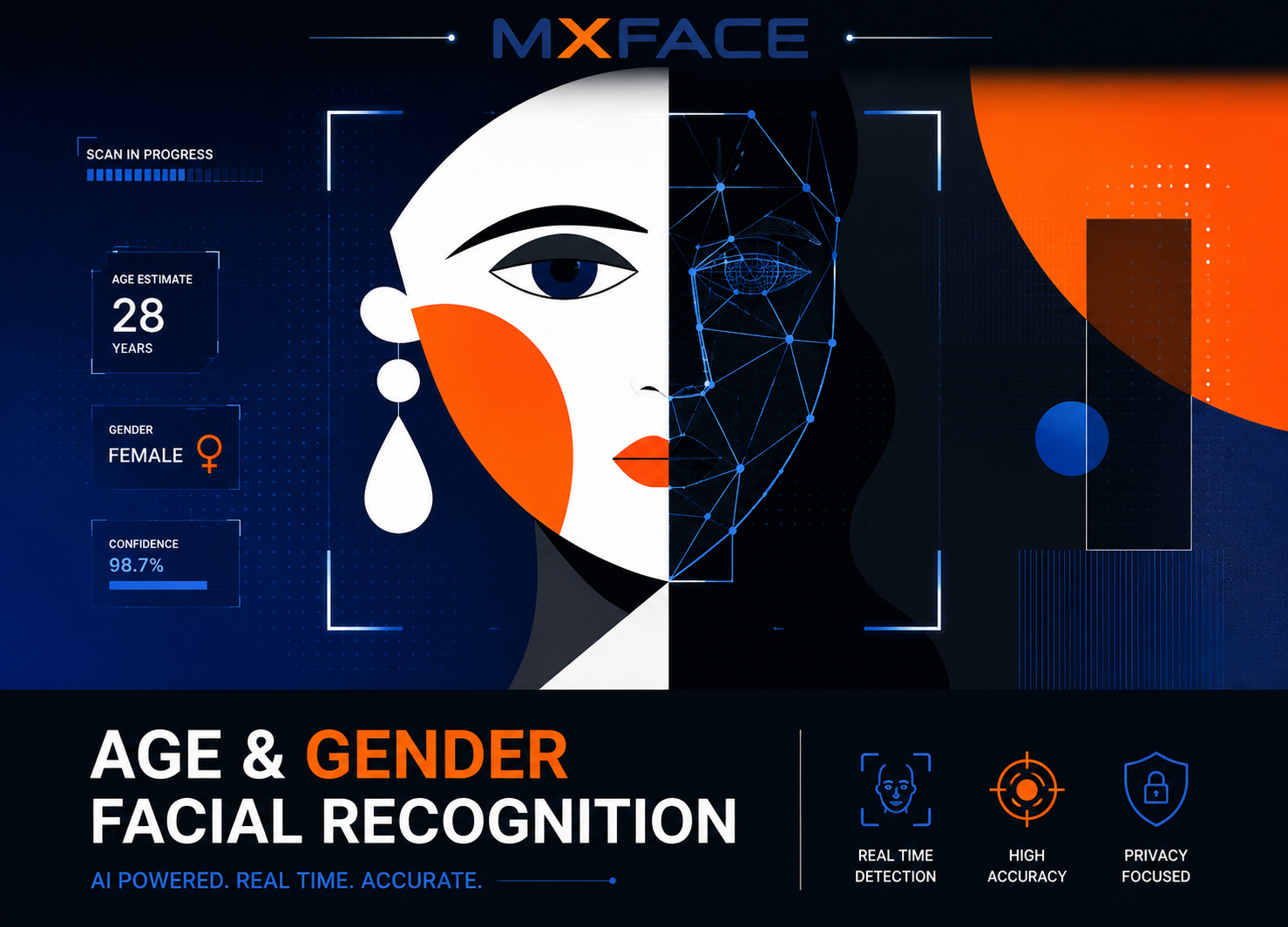
There's a moment when you upload a selfie to an app and it guesses your age. Sometimes flattering, sometimes brutal. Either way, something quietly impressive just happened — a model analyzed your bone structure, skin texture, and dozens of other signals in milliseconds. But how does it actually work, and how reliable is it really?
Age and gender detection has grown from a niche computer vision task into a core feature powering retail analytics, healthcare tools, security systems, and personalized digital experiences.
Why Age and Gender Detection Is Harder Than It Looks
A human face is not a static object. Lighting shifts it. Angles distort it. Age transforms it over decades, and even emotions temporarily alter its structure. Teaching a model to make consistent predictions across all those variables is genuinely difficult.
Age estimation is especially tricky because it's not a fixed label — it's a continuous range. A model doesn't just classify; it has to regress — predicting a number or age bracket rather than choosing between clean categories like "cat" vs "dog."
Gender detection adds another layer. Facial gender expression varies widely across individuals and cultures, and binary classification doesn't capture that spectrum accurately for everyone. The best modern systems acknowledge this openly.
How Deep Learning Actually Reads a Face
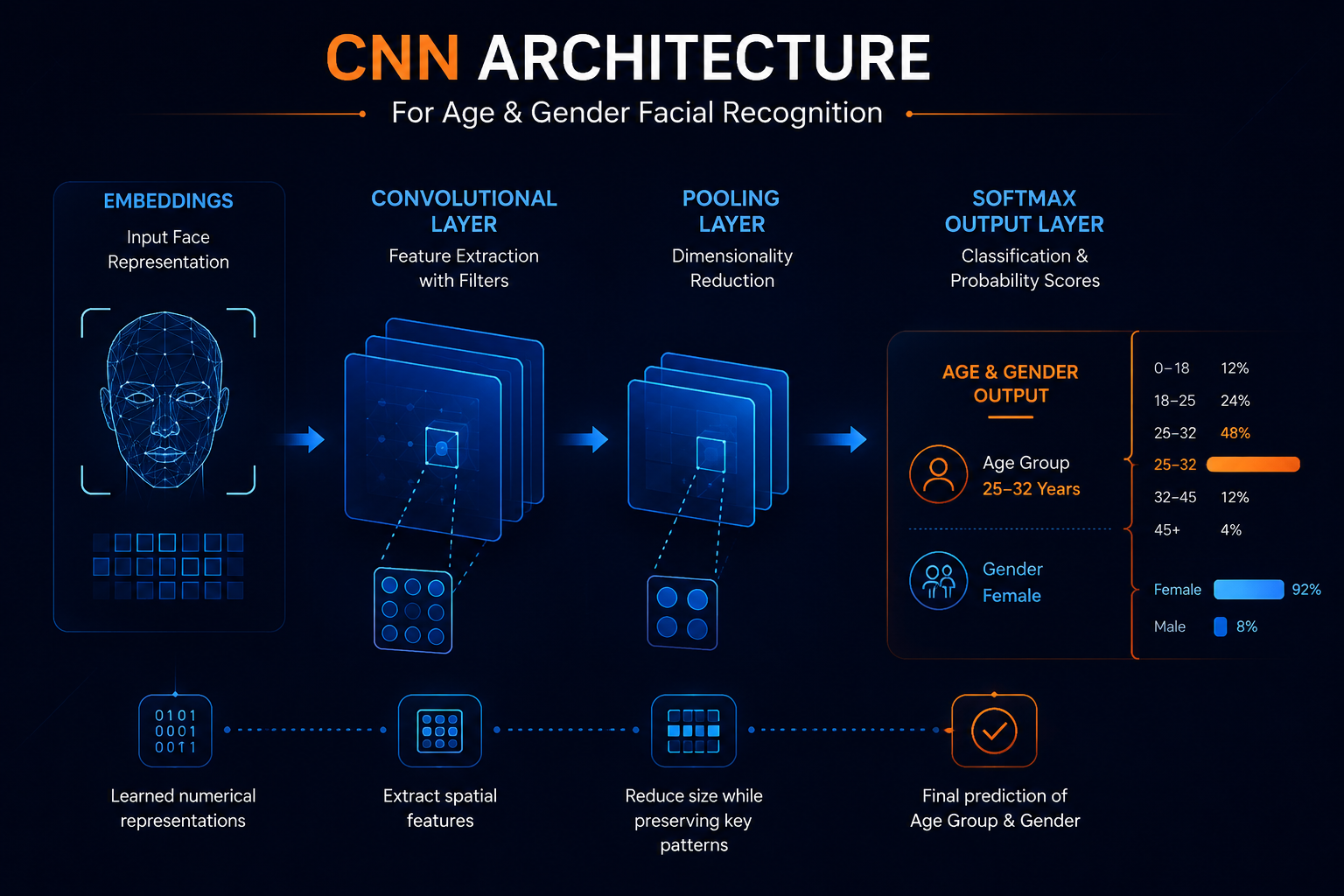
Modern models don't "look" at a face the way you do. They process it as a grid of pixel values and extract hierarchical features — edges first, then shapes, then high-level patterns like cheekbone distance or jawline curvature.
Convolutional Neural Networks have been the backbone of this process for over a decade. A CNN passes filters across an image to detect local patterns, stacks those detections layer by layer, and arrives at a confident prediction.
CNNs vs Vision Transformers — What's Actually Winning
Both approaches have real traction. Lightweight CNNs — think MobileNetV3 or EfficientNet-B0 — still dominate mobile and edge deployments where speed and memory matter most.
Vision Transformers, particularly hybrid variants combining local CNN extraction with transformer-based attention, are setting new benchmarks on age estimation datasets. The tradeoff is computational cost — ViTs need significantly more resources to train and serve.
For most production applications, the smartest choice isn't the most advanced model. It's the right model for your deployment environment. Transfer learning remains one of the most practical tools: starting from ImageNet-pretrained weights and fine-tuning on labeled facial data cuts training time dramatically.
The Bias Problem Nobody Talks About Enough
Multiple peer-reviewed studies, including NIST reports, have shown that facial recognition models perform unequally across demographic groups. Accuracy drops for darker skin tones, older faces, and underrepresented regions.
The root cause is almost always the training data. Fix it at the source — curate intentionally, audit regularly, and document limitations honestly. Bias mitigation isn't a one-time patch; it's a continuous practice.
Real-World Applications Driving Demand
Age and gender detection has found genuine utility across industries:
- Retail — adaptive content personalization based on estimated demographic data, anonymously, without storing identity.
- Healthcare — non-invasive age estimation from facial images is being explored as a signal for biological aging markers.
- Age verification — AI-assisted first-pass filtering for age-restricted platforms before manual review.
- Security analytics — demographic pattern analysis in controlled environments, subject to local legal frameworks.
Each use case carries its own accuracy requirements and ethical obligations. A system built for retail analytics should never be repurposed for identity verification without fundamental rethinking.
FAQs
How do you reduce gender bias in a model?
Train with balanced, diverse data across genders, skin tones, and age groups. Audit regularly and retrain when bias patterns emerge.
Does age estimation work on all face angles?
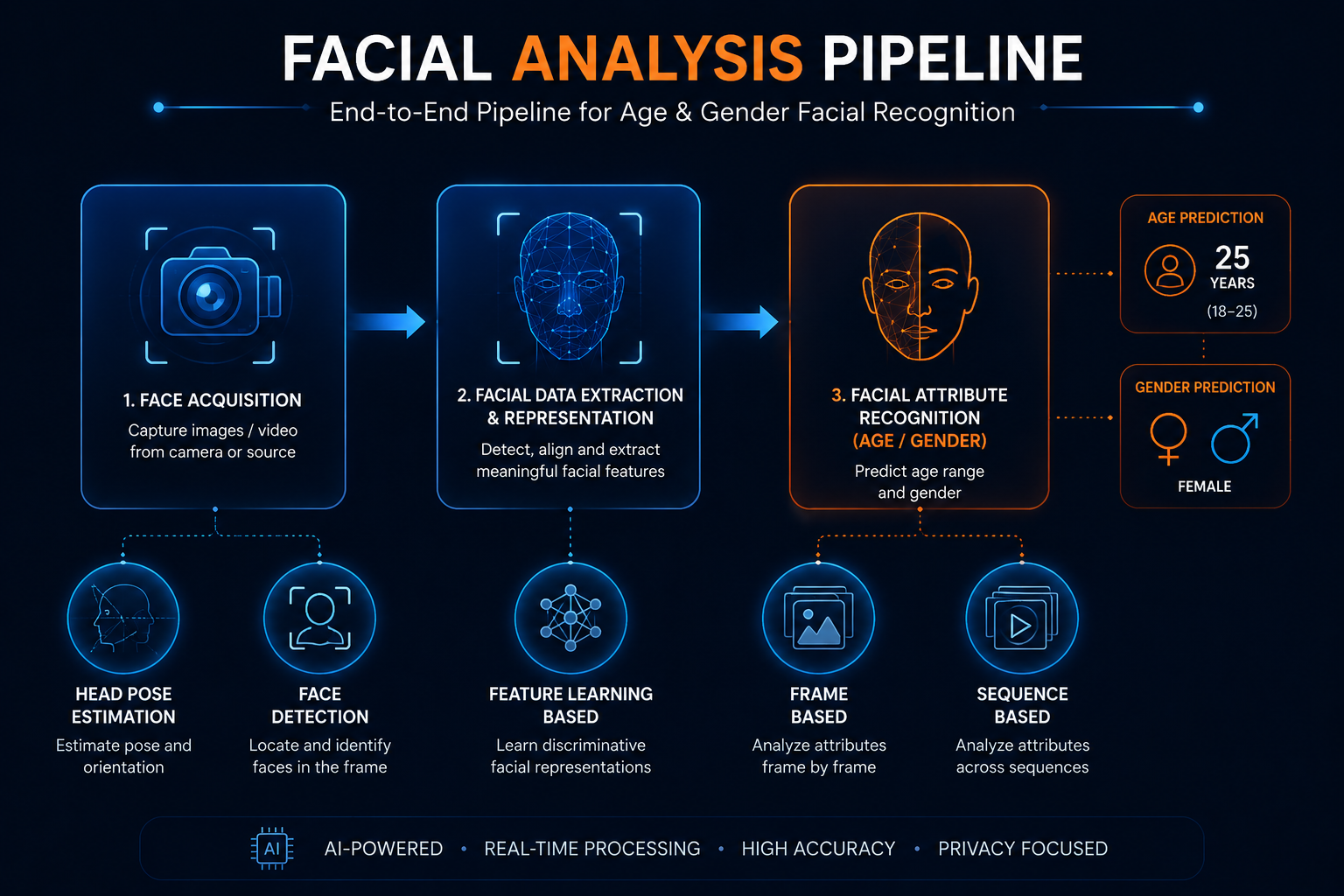
Frontal faces yield the most accurate results. Most production systems use pose normalization as a preprocessing step.
What's the difference between facial attribute detection and facial recognition?
Facial recognition identifies who someone is by matching a known database. Attribute models predict characteristics like age or gender — no identity matching involved.
Wrapping Up
Age and gender detection is mature enough to be genuinely useful — and complex enough that implementation details matter enormously. The best results come from carefully chosen architectures, diverse training data, and an honest view of where models fall short.
If you're building something that relies on facial attribute analysis, the infrastructure underneath it matters as much as the model. MxFace.ai offers production-ready facial analysis APIs built for accuracy, speed, and responsible deployment — a strong starting point whether you're prototyping or scaling to millions of requests.
Both images are retained, repurposed with better captions, and placed where they add maximum explanatory value — not just decoratively dropped in as the old blog did.


