Fingerprint Recognition: How Fingerprint Biometrics Enables Secure Identity Verification
Fingerprint recognition is one of the most widely used biometric technologies for verifying a person's identity. It uses the unique patterns found on the surface of a finger to identify or authenticate individuals. From smartphones and office attendance systems to banking, healthcare, and government identity programs, fingerprint biometrics plays an important role in modern security.
Unlike passwords or PINs, fingerprints are physical characteristics that are naturally associated with an individual. A fingerprint recognition system captures a fingerprint image, analyzes its patterns, extracts distinctive features, and compares them with a stored biometric template.
With advances in artificial intelligence (AI), computer vision, and biometric matching algorithms, fingerprint recognition systems are becoming more flexible and easier to integrate into digital identity applications.
Platforms such as MxFace.ai support the growing biometric technology ecosystem by providing AI-powered recognition capabilities and API-based solutions that organizations can integrate into their applications.
What Is Fingerprint Recognition?
Fingerprint recognition is a biometric technology that identifies or verifies a person by analyzing the unique ridge and valley patterns present on their fingertip.
The raised lines on a finger are called ridges, while the spaces between them are known as valleys. These patterns form distinctive structures that can be analyzed by a biometric system.
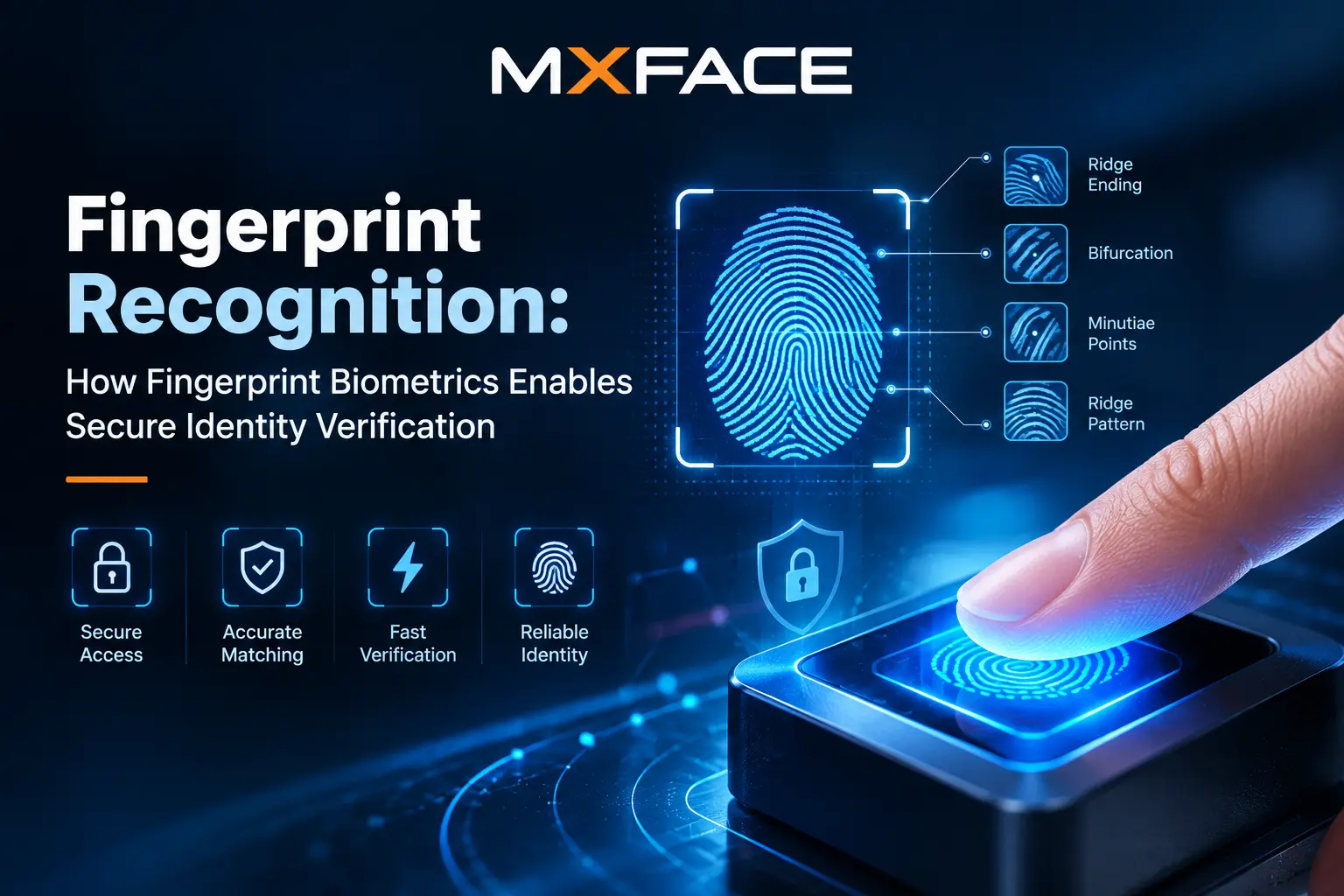
Fingerprint recognition commonly examines features such as:
- Ridge endings: Points where a ridge terminates.
- Bifurcations: Points where one ridge divides into two branches.
- Ridge patterns: Larger structures such as loops, whorls, and arches.
- Minutiae points: Small, distinctive characteristics used for biometric matching.
- Ridge orientation: The direction in which fingerprint ridges flow.
A fingerprint recognition system extracts relevant characteristics from a captured image and converts them into a digital representation called a biometric template.
The template can then be compared with another fingerprint template to determine whether the samples are sufficiently similar.
How Does Fingerprint Recognition Work?
Fingerprint recognition involves multiple processing stages. Each stage contributes to the quality and reliability of the final matching result.
1. Fingerprint Image Capture
The process begins when a fingerprint sensor captures an image of the fingertip.
Different types of sensors are used depending on the application.
Optical sensors capture fingerprint patterns using light and image sensors.
Capacitive sensors detect differences in electrical capacitance between fingerprint ridges and valleys.
Ultrasonic sensors use sound waves to capture information about the finger's surface and, in some implementations, features beneath it.
The choice of sensor depends on the device, security requirements, operating environment, and expected image quality.
2. Image Preprocessing
The captured fingerprint image may contain noise, uneven illumination, smudges, or incomplete ridge patterns.
Preprocessing techniques help improve the image before feature extraction begins.
Common operations include:
- Noise reduction
- Contrast enhancement
- Image normalization
- Ridge enhancement
- Background removal
- Image quality assessment
The objective is to make the useful fingerprint patterns easier to analyze without introducing misleading information.
3. Fingerprint Segmentation
Segmentation identifies the region of the image that contains usable fingerprint information.
It helps separate the fingerprint from the background and excludes areas that do not contain sufficient ridge detail.
Accurate segmentation is important because background noise or incomplete fingerprint regions can affect the reliability of feature extraction.
4. Feature Extraction
After preprocessing, the system identifies distinctive fingerprint characteristics.
Traditional fingerprint recognition algorithms often focus on minutiae points, including ridge endings and bifurcations. Other methods can analyze ridge orientation, texture, and broader fingerprint structures.
AI-based models can also learn useful representations from fingerprint images.
The extracted features form the basis of the biometric template used during matching.
5. Biometric Template Generation
The system converts the extracted characteristics into a structured digital representation.
This representation is known as a fingerprint template.
A biometric template is designed to support matching rather than simply storing the fingerprint as an ordinary image. However, templates remain sensitive biometric information and should be protected with appropriate security controls.
Depending on the system, templates may be stored securely on a device, in an organization's infrastructure, or in a biometric database.
6. Fingerprint Matching
During matching, the system compares a newly captured fingerprint template with an enrolled template.
The matching algorithm evaluates similarities between the available biometric features. Depending on the algorithm, it may account for differences in finger position, rotation, pressure, and partial fingerprint capture.
The system generates a matching score and compares it with a configured threshold.
If the score satisfies the decision criteria, the system may accept the match. Otherwise, the fingerprint may be rejected or sent for another attempt.
7. Identity Verification or Identification
After matching, the system produces a result based on the type of biometric search being performed.
For verification, it determines whether the captured fingerprint matches the claimed identity.
For identification, it searches across multiple enrolled templates to find a possible match.
The final result can be used by an application to grant access, authenticate a transaction, or support an identity management process.
Fingerprint Recognition Workflow
The following workflow summarizes the major stages of a fingerprint recognition system, from image capture to the final identity decision.
This workflow may vary depending on the fingerprint sensor, algorithm, application, and security requirements.
Fingerprint Verification vs Fingerprint Identification
Fingerprint recognition supports two primary matching approaches: 1:1 verification and 1:N identification.
1:1 Fingerprint Verification
In 1:1 verification, the system compares a captured fingerprint with the template associated with a claimed identity.
The question is: “Is this person who they claim to be?”
For example, an employee places a finger on a scanner after entering an employee ID. The system compares the fingerprint with the template enrolled for that employee.
This method is useful for employee authentication, device unlocking, and controlled access systems.
1:N Fingerprint Identification
In 1:N identification, the system compares a captured fingerprint against multiple templates in a database.
The question is: “Whose fingerprint is this?”
For example, a biometric identification system may search a collection of enrolled fingerprints to find a potential identity match.
Identification systems require efficient search and matching techniques, especially when working with large biometric databases.
The best approach depends on the application, database size, response-time requirements, and acceptable error rates.
Benefits of Fingerprint Recognition
Fingerprint biometrics offers several advantages for identity verification and authentication.
1. Convenient Authentication
Users can authenticate by presenting a finger instead of remembering passwords or carrying separate access credentials.
2. Distinctive Biometric Patterns
Fingerprint ridge structures provide detailed characteristics that can support reliable matching when image quality and algorithm performance are suitable.
3. Fast Processing
Modern fingerprint systems can process images and compare templates quickly, making them suitable for many real-time authentication applications.
4. Broad Device Support
Fingerprint sensors are available in smartphones, laptops, attendance terminals, access control devices, and dedicated biometric equipment.
5. Integration with Existing Systems
Fingerprint recognition can be integrated with identity management platforms, employee systems, and authentication workflows through suitable software interfaces.
6. Support for Multimodal Biometrics
Fingerprint recognition can be combined with facial recognition, iris recognition, or other authentication factors to strengthen an identity verification process.
However, the actual security level depends on the implementation, enrollment process, sensor quality, template protection, and resistance to spoofing attacks.
Applications of Fingerprint Recognition
Fingerprint recognition is used across several industries where identity verification and access control are important.
Banking and Financial Services
Financial institutions can use fingerprint authentication in supported devices and workflows to verify users and protect access to services.
Fingerprint biometrics may also be part of multi-factor authentication systems.
Healthcare
Hospitals and healthcare organizations can use fingerprint systems to help identify patients, authenticate authorized staff, and manage access to restricted areas.
Implementations must account for hygiene, accessibility, and situations in which fingerprints cannot be captured reliably.
Employee Attendance
Organizations can integrate fingerprint scanners with attendance management systems to record employee check-ins and check-outs.
This can reduce manual attendance entry and support more consistent record management.
Government Identity Programs
Government agencies may use fingerprint biometrics for identity enrollment, deduplication, and verification, depending on the requirements of the specific program.
Large-scale systems require careful attention to accuracy, privacy, security, and database performance.
Access Control
Fingerprint authentication can help control entry to offices, laboratories, server rooms, and other restricted environments.
Access policies can be combined with employee credentials or additional authentication methods.
Mobile Devices
Fingerprint sensors are commonly used to unlock devices and authorize supported actions.
In many consumer devices, fingerprint matching occurs locally within a protected hardware or software environment.
Education and Enterprise
Educational institutions and businesses may use fingerprint technology for attendance, identity checks, and controlled access, subject to applicable privacy rules and organizational policies.
Role of AI in Fingerprint Recognition
Artificial intelligence is expanding the capabilities of fingerprint recognition systems.
Traditional algorithms rely on carefully designed image-processing and feature-matching techniques. AI-based approaches can learn patterns from training data and support different stages of biometric analysis.
AI can contribute to:
- Fingerprint image quality assessment
- Ridge pattern enhancement
- Fingerprint classification
- Minutiae detection
- Feature representation
- Biometric matching
- Presentation attack detection
- Automated quality checks
Deep learning models can help analyze complex fingerprint images, including some samples affected by noise or incomplete ridge patterns. Performance still depends on the quality and diversity of training data and on evaluation under realistic operating conditions.
AI does not eliminate every challenge. Poor sensor quality, partial fingerprints, damaged skin, and unsuitable capture conditions can still affect matching accuracy.
Fingerprint Recognition vs Face and Iris Recognition
Fingerprint, face, and iris recognition are all biometric technologies, but they analyze different physical characteristics.
| Biometric Technology | Main Feature | Common Applications |
|---|---|---|
| Fingerprint Recognition | Ridge patterns and minutiae | Device authentication, attendance, access control |
| Face Recognition | Facial characteristics and learned facial representations | Identity verification, access control, digital onboarding |
| Iris Recognition | Detailed patterns of the iris | High-assurance verification and identity systems |
Fingerprint recognition usually requires a suitable fingerprint sensor or image source. Face recognition can often work with compatible cameras, while iris recognition requires eye images with enough usable iris detail.
No single biometric modality is ideal for every situation. Organizations should select technology based on accuracy requirements, capture conditions, user accessibility, privacy considerations, and deployment costs.
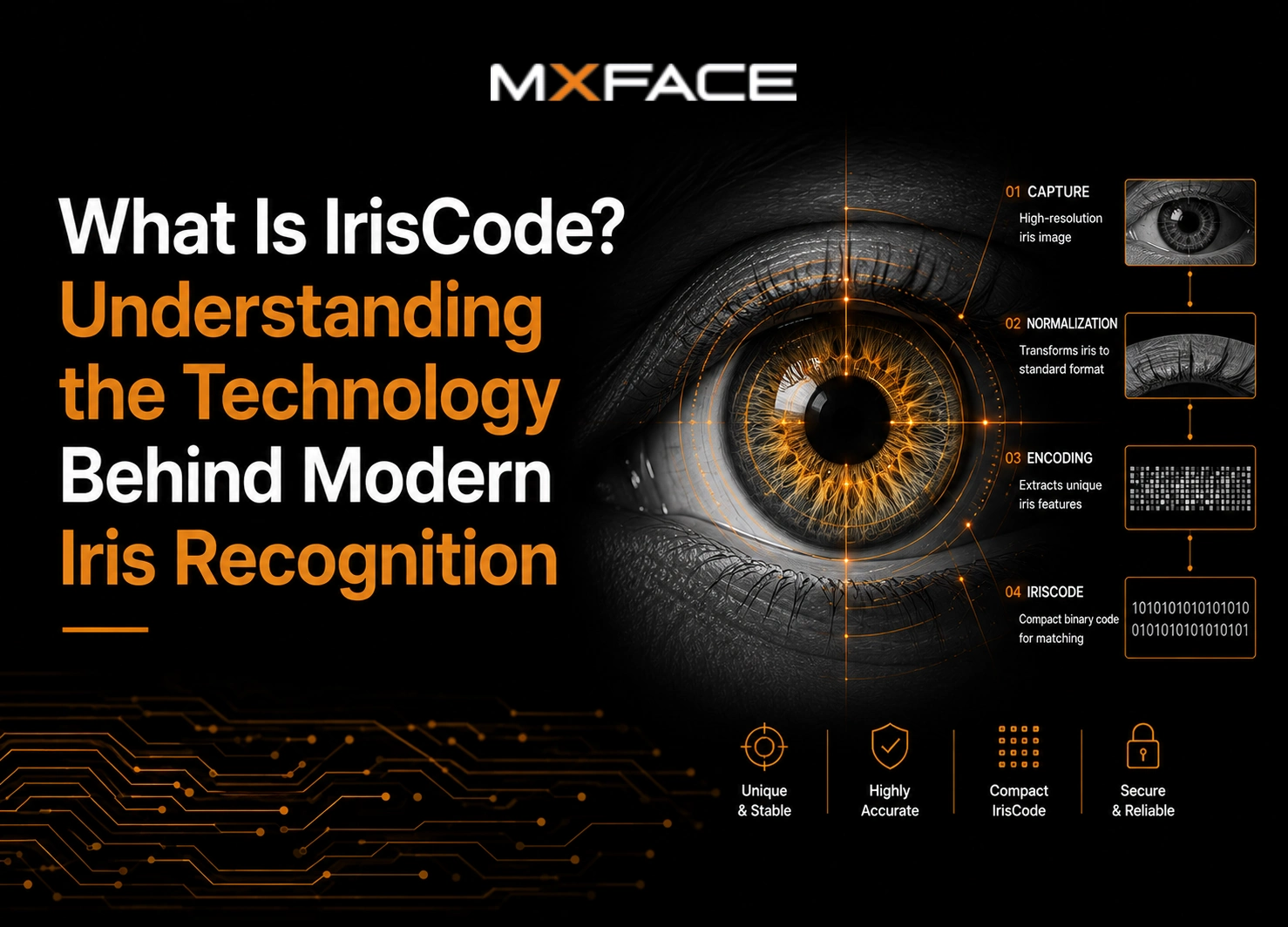
Fingerprint Recognition and Multimodal Biometrics
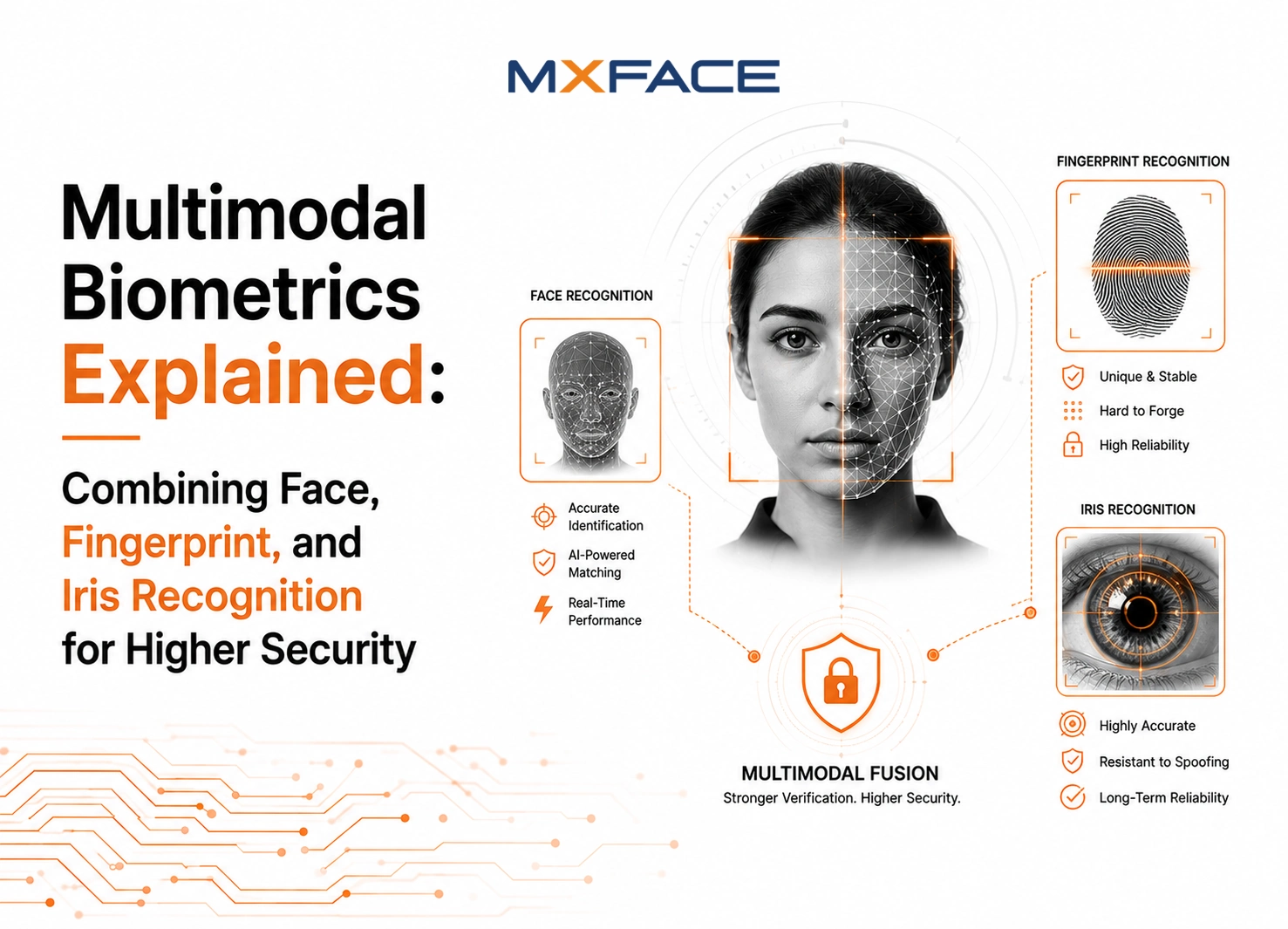
Multimodal biometrics combines two or more biometric characteristics to support identity verification.
For example, an organization may combine fingerprint recognition with facial recognition or iris recognition.
A multimodal workflow can look like this:
Identity Enrollment → Fingerprint Capture → Face Capture → Biometric Template Generation → Matching and Score Evaluation → Authentication Decision
The system can combine biometric evidence at different stages, depending on its architecture.
Multimodal systems may improve reliability in situations where one biometric modality produces an unusable sample. They can also make attacks more difficult when properly designed, although combining modalities does not automatically guarantee stronger security.
Organizations must still consider privacy, consent, secure storage, presentation attack detection, and appropriate fallback procedures.
Common Challenges in Fingerprint Recognition
Despite its advantages, fingerprint recognition has several practical challenges.
- Poor image quality: Low-resolution or noisy images may contain insufficient ridge detail.
- Dry or wet fingers: Skin conditions and moisture can affect fingerprint capture.
- Damaged fingerprints: Cuts, scars, or worn ridge patterns can make matching more difficult.
- Partial fingerprints: A sensor may capture only part of the finger, reducing the available biometric information.
- Sensor limitations: Different sensors may produce images with different quality characteristics.
- Spoofing attempts: Attackers may attempt to present artificial fingerprint replicas to deceive a sensor.
- Template security: Biometric templates must be protected against unauthorized access and misuse.
To address these challenges, organizations should use suitable sensors, image quality checks, secure template management, and presentation attack detection where appropriate.
Fingerprint Recognition with MxFace.ai
MxFace.ai provides AI-powered biometric and computer vision technologies designed to help developers and organizations integrate identity-related capabilities into their applications.
Its biometric technology portfolio includes facial recognition capabilities and supports broader biometric use cases involving technologies such as fingerprint and iris recognition. The availability of a specific fingerprint recognition API should be confirmed against the current MxFace.ai product documentation.
Organizations developing biometric solutions can explore API-based integration to connect supported recognition services with existing business applications.
Potential use cases include:
- Digital identity verification
- Employee authentication workflows
- Enterprise security
- Access management
- Customer onboarding
- Biometric application development
- Multimodal identity solutions
An API-based architecture can simplify integration by allowing developers to connect supported biometric functions without building every processing component themselves.
When selecting a biometric platform, businesses should evaluate supported modalities, matching performance, integration requirements, data retention practices, privacy controls, and security documentation.
Security and Privacy in Fingerprint Recognition
Fingerprint data is sensitive because it represents a person's biometric characteristics. Unlike a password, a person's underlying fingerprint cannot simply be changed if the associated biometric information is compromised.
Organizations should implement appropriate safeguards, including:
- Encryption of biometric data in transit and at rest
- Access controls for biometric databases
- Secure template storage
- Clear data retention policies
- Consent and transparency where required
- Monitoring and auditing of access
- Presentation attack detection where appropriate
- Compliance with applicable privacy and data protection laws
Whenever possible, systems should collect only the biometric information needed for their intended purpose.
Security must be considered throughout the biometric lifecycle, from enrollment and capture to matching, storage, deletion, and system maintenance.
Future of Fingerprint Recognition
Fingerprint recognition continues to evolve with improvements in sensors, AI algorithms, edge computing, and biometric security.
Newer approaches are focusing on improving fingerprint image quality, processing partial fingerprints, optimizing matching performance, and detecting presentation attacks.
Integration with cloud services and APIs can also help developers build biometric functions into digital applications more efficiently.
Another important direction is multimodal authentication, where fingerprint recognition works alongside face, iris, or other identity verification methods.
As organizations adopt digital identity solutions, fingerprint biometrics is likely to remain an important technology for authentication and access management.
Conclusion
Fingerprint recognition is a well-established biometric technology that uses distinctive ridge patterns and minutiae to verify or identify individuals. Its applications range from mobile devices and employee attendance to financial services, healthcare, access control, and government identity systems.
The recognition process includes image capture, preprocessing, segmentation, feature extraction, template generation, and biometric matching. Each stage contributes to the quality and reliability of the final result.
AI is helping improve fingerprint analysis, while multimodal biometrics offers additional options for identity verification. At the same time, accurate capture, secure template management, privacy protection, and spoof detection remain essential.
With platforms such as MxFace.ai supporting the broader biometric technology ecosystem, developers can explore ways to integrate suitable AI-powered recognition capabilities into modern applications.
As biometric technologies continue to advance, fingerprint recognition will remain a valuable component of secure, convenient, and intelligent identity verification systems.