Human Detection Technology: Pose-Invariant Computer Vision for Real-Time People Detection and Tracking

Human detection technology has become an important part of modern computer vision systems used for security, surveillance, smart infrastructure, retail analytics, transportation, workplace monitoring, and automation. By using artificial intelligence and computer vision, human detection systems can identify people in images and video streams, even when individuals appear at different angles, distances, or poses.
Traditional monitoring systems often depend on manual observation, which can become difficult when cameras generate large amounts of video data. AI-powered human detection can automatically analyze video frames and identify human figures in real time. Advanced systems can also track detected people as they move through a scene, providing useful information for applications that require continuous monitoring.
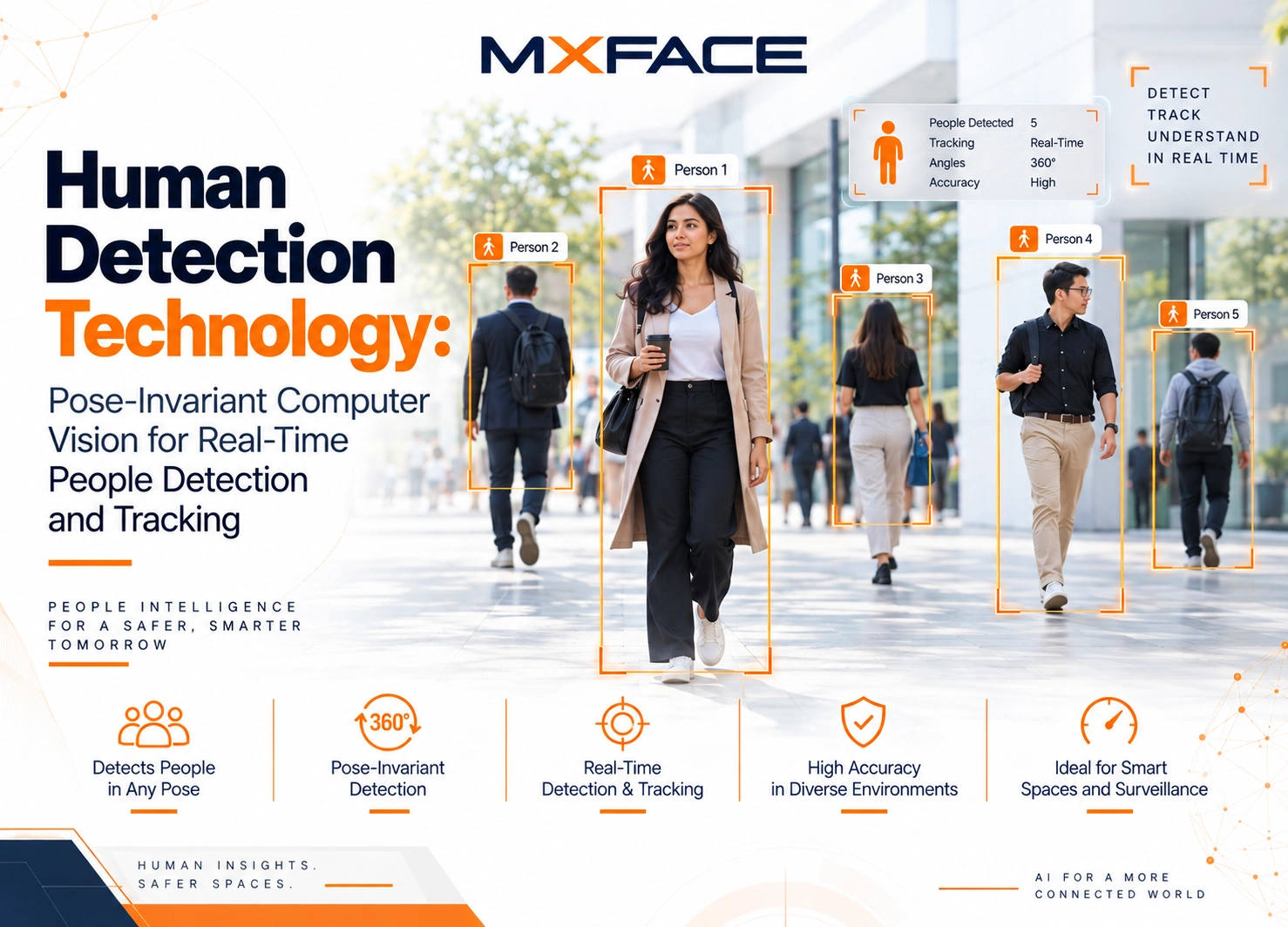
One important development in this field is pose-invariant human detection. Instead of depending on a person appearing in one specific position, modern computer vision models can detect people across different body orientations, poses, and viewing conditions. This makes human detection more practical for real-world environments where people rarely remain stationary or face the camera directly.
What Is Human Detection Technology?
Human detection technology is a computer vision capability that identifies the presence and location of people within an image or video frame. The system analyzes visual information and determines which regions contain human figures.
Unlike face detection, which specifically looks for a person's face, human detection focuses on the presence of the whole human body or human-shaped regions. This allows systems to detect people even when their faces are not clearly visible.
For example, a surveillance camera may capture a person walking away from the camera. Their face may not be visible, but their body can still be detected by a human detection model.
Modern human detection systems can support:
- Real-time person detection
- Full-body human detection
- Detection across different poses
- Detection from different camera angles
- Multiple-person detection
- Human tracking across video frames
- Region-based monitoring
- People counting and occupancy analysis
How Does Human Detection Work?
A human detection system generally combines image processing, deep learning, object detection, and tracking techniques. The system receives an image or video frame and processes it to determine whether one or more humans are present.
The basic process includes image capture, preprocessing, feature extraction, object detection, confidence evaluation, and optional tracking.
Deep learning models are trained on large datasets containing images of people in different environments. During inference, the trained model analyzes new images and predicts the locations of human objects.
Pose-Invariant Human Detection
One of the biggest challenges in human detection is the large variation in human appearance. People can stand, sit, walk, run, bend, crouch, or partially turn away from the camera.
Pose-invariant human detection aims to maintain reliable detection across these different body configurations. Instead of depending on a fixed visual pattern, advanced models learn a broader representation of human appearance.
This is particularly useful in real-world environments because camera footage rarely contains people standing in a standardized position.
For example, a smart surveillance system may observe:
- A person walking toward the camera
- A person walking away from the camera
- A person standing sideways
- A person sitting in a vehicle
- A person partially blocked by another person
- Multiple people moving through the same area
A robust detection model should be designed to handle these variations without depending on a single pose.
Human Detection vs Face Detection
Human detection and face detection are related computer vision technologies, but they solve different problems.
Face detection identifies the location of faces in an image. It is commonly used before facial recognition, facial landmark detection, age and gender estimation, and other face-related analysis.
Human detection identifies people based on their body or overall visual appearance. It can therefore detect an individual even when their face is too small, turned away, covered, or outside the camera's visible area.
For many surveillance and monitoring applications, human detection provides an important additional layer because the system can determine whether people are present without requiring a visible face.
Human Detection and Object Detection
Human detection is generally considered a specialized form of object detection. Object detection models can identify different categories of objects, while a human detection system focuses specifically on people.
An object detection model may identify categories such as vehicles, bicycles, animals, and people. A human detection system is optimized around the detection of the human class and the conditions in which people appear.
The output commonly contains a bounding box around each detected person along with a confidence score. These results can then be used by other application components.
Real-Time Human Detection and Tracking
Detecting a person in a single image is different from tracking a person across a video. Real-time human detection and tracking combines detection with temporal information from consecutive frames.
For example, a camera may detect a person in one frame and then locate the same person in subsequent frames. A tracking system can associate these detections and maintain a temporary track as the person moves.
This can support applications such as:
- People counting
- Footfall analysis
- Restricted-area monitoring
- Queue monitoring
- Occupancy measurement
- Movement analysis
- Traffic and pedestrian monitoring
Human Detection Technology Workflow
| Stage | Process | Purpose |
|---|---|---|
| 1. Video/Image Capture | Camera or image source provides visual input | Collect frames for analysis |
| 2. Preprocessing | Frames are prepared for model inference | Improve consistency and processing efficiency |
| 3. Human Detection | AI model identifies human regions | Locate people within the frame |
| 4. Confidence Evaluation | Predictions are evaluated against detection thresholds | Filter unreliable detections |
| 5. Tracking | Detections are associated across consecutive frames | Follow movement over time |
| 6. Application Output | Results are sent to the connected application | Enable monitoring, analytics, alerts, or automation |
Factors That Affect Human Detection Accuracy
The performance of a human detection system depends on several factors. The quality of the AI model is important, but the surrounding environment can also significantly influence results.
Lighting Conditions
Very dark scenes, excessive brightness, glare, or rapidly changing illumination can make people more difficult to detect.
Camera Position
The camera's height, viewing angle, field of view, and distance from people can affect the visual information available to the model.
Occlusion
People may be partially hidden behind objects, vehicles, furniture, or other people. Strong detection systems need to handle partial visibility as effectively as possible.
Person Size
A person occupying only a small number of pixels in a video frame can be more difficult to detect than someone located close to the camera.
Scene Density
Crowded environments create additional challenges because people can overlap with one another. The detection system needs to distinguish individual human instances even when their bodies are close together.
Applications of Human Detection Technology
Human detection has applications across many industries because the technology can provide automated awareness of people within a monitored environment.
Security and Surveillance
Security systems can use human detection to identify people entering monitored areas. Detection events can be connected with alerts, recording systems, or additional analytics.
Smart Retail
Retail environments can use people detection for footfall measurement, occupancy analysis, customer movement analysis, and queue monitoring.
Transportation
Transportation environments such as roads, stations, terminals, and parking facilities can use human detection to monitor pedestrians and identify movement within designated areas.
Workplace Monitoring
Businesses can use human detection for occupancy monitoring, restricted-zone awareness, and workplace analytics where appropriate privacy and compliance measures are followed.
Smart Cities
Smart city infrastructure can use computer vision to analyze pedestrian activity and support traffic management, public-space monitoring, and infrastructure planning.
Industrial Environments
Factories and warehouses can use human detection to monitor operational areas and support safety-related workflows, especially around restricted or controlled zones.
Human Detection with MxFace.ai
MxFace.ai provides AI-powered biometric and computer vision technologies that can be integrated into modern digital applications. Its technology portfolio includes capabilities across face recognition, biometric authentication, liveness detection, and human detection.
For organizations building applications that require automated people detection, a human detection API can simplify integration by allowing developers to connect detection capabilities with their existing software systems.
A human detection workflow can be connected to broader MxFace.ai capabilities depending on the application requirements. For example, a system may first detect a person and then use a separate biometric process when identity verification is required.
This separation between detection and identification is important. Human detection answers whether a person is present and where that person is located. Facial recognition or another biometric technology can then be used when the application needs to determine identity.
Why API-Based Human Detection Matters
Developing an entire computer vision pipeline internally can require significant engineering resources, model development, testing, infrastructure, and ongoing maintenance. An API-based approach can provide developers with a simpler integration path.
With an API, an application can send supported visual input to a detection service and receive structured results that can be processed by the application's existing workflow.
Depending on the implementation, these results can support:
- Human presence detection
- Bounding-box information
- Confidence-based filtering
- People counting workflows
- Video analytics pipelines
- Security monitoring applications
- Smart infrastructure systems
Human Detection and Privacy
Human detection does not necessarily require identifying a person. This distinction can be important when designing privacy-conscious computer vision applications.
A system may only need to determine how many people are present in an area or whether a restricted zone is occupied. In such cases, identifying individual people may not be necessary.
Organizations should define appropriate data retention, access control, encryption, and processing policies based on their application, regulatory environment, and the type of information being processed.
When human detection is combined with biometric identification, additional privacy and data-protection considerations become important because biometric information can be sensitive.
Future of Pose-Invariant Human Detection
Computer vision is continuing to evolve toward models that can operate across more complex environments. Future human detection systems are expected to focus on better handling of crowded scenes, difficult lighting, partial visibility, camera movement, and diverse human poses.
Another important direction is the integration of detection with other AI capabilities. A single application may combine human detection, object detection, tracking, facial analysis, biometric recognition, and contextual analytics.
This can create a more complete computer vision pipeline where each technology performs a specific function rather than trying to solve every problem with a single model.
Conclusion
Human detection technology provides an important foundation for modern computer vision applications. By identifying people across different poses, viewpoints, and environments, AI-powered detection systems can support security, surveillance, retail, transportation, industrial monitoring, and smart infrastructure applications.
Pose-invariant human detection is particularly valuable because real-world environments are unpredictable. People may move, turn, sit, overlap, or appear partially visible, making flexible computer vision models essential for reliable detection.
With API-based solutions from MxFace.ai, organizations can integrate human detection and other biometric technologies into their applications while building workflows tailored to their specific requirements. As computer vision continues to advance, the combination of real-time detection, tracking, biometric recognition, and intelligent analytics will play an increasingly important role in automated visual systems.