

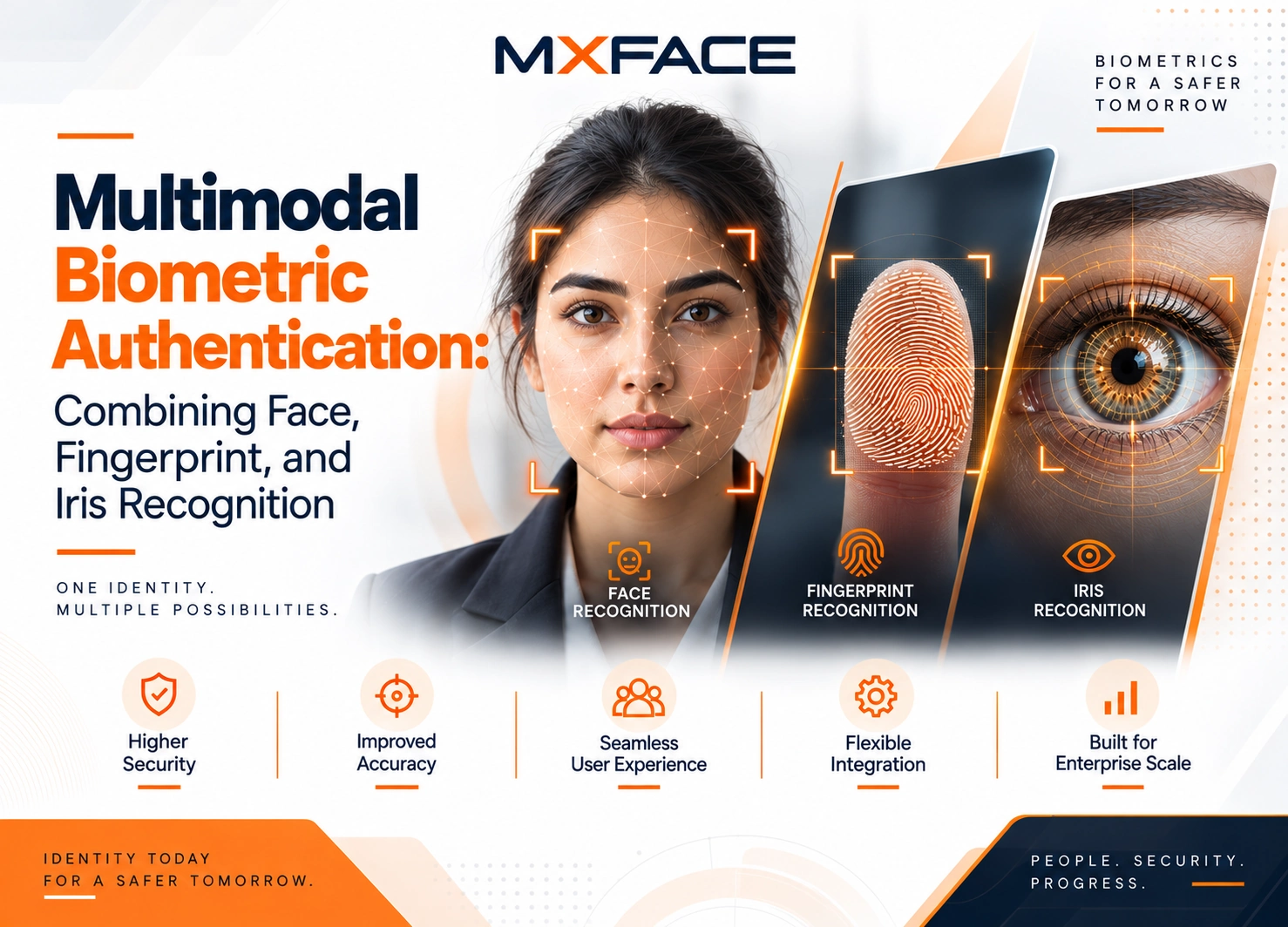
Multimodal Biometric Authentication: Combining Face, Fingerprint, and Iris Recognition
Modern identity systems increasingly need more than a single method of authentication. Passwords and PINs can be forgotten, shared, or compromised, while a single biometric modality may not work equally well in every environment. Multimodal biometric authentication addresses this challenge by combining two or more biometric modalities, such as face, fingerprint, and iris recognition, within a single identity workflow.
Each biometric modality has different characteristics. Facial recognition can provide a contactless authentication experience, fingerprint recognition can deliver a compact and widely adopted biometric method, and iris recognition can use highly distinctive patterns around the eye. When these technologies are combined appropriately, organizations can create flexible authentication architectures that select or fuse biometric evidence according to the application's requirements.
This article explains how multimodal biometric authentication works, how face, fingerprint, and iris recognition complement each other, common fusion approaches, implementation considerations, use cases, and how developers can build multimodal biometric workflows using modern APIs and SDKs.
What Is Multimodal Biometric Authentication?
Multimodal biometric authentication is an identity verification or identification process that uses multiple biometric characteristics from the same person. Instead of relying only on a face, fingerprint, or iris, the system can combine information from multiple modalities to make an authentication decision.
A simple multimodal workflow may look like:
User
  ↓
Biometric Capture
  ↓
┌──────────────┬───────────────┬──────────────┐
│ Face         │ Fingerprint   │ Iris         │
│ Recognition  │ Recognition   │ Recognition  │
└──────────────┴───────────────┴──────────────┘
        ↓
Feature Extraction
        ↓
Biometric Matching
        ↓
Score / Evidence Fusion
        ↓
Authentication Decision
The system does not necessarily need to collect all three biometrics every time. Depending on the application, it can use multiple modalities simultaneously, use one as a primary modality and another as a fallback, or dynamically select a modality based on environmental and operational conditions.
Why Combine Face, Fingerprint, and Iris?
Every biometric modality has different strengths and limitations. Face recognition is convenient because it can work without physical contact, but image quality, lighting, pose, and occlusion can influence performance. Fingerprint recognition provides highly detailed ridge patterns, but it requires suitable contact or contactless capture hardware and may be affected by damaged or unclear fingerprints.
Iris recognition analyzes the complex pattern of the iris. It can provide another independent biometric signal, but it requires suitable image capture conditions and positioning.
Combining these modalities gives system architects more options when designing identity workflows.
- ➜ Face recognition: Contactless and suitable for convenient identity verification.
- ➜ Fingerprint recognition: Uses distinctive ridge patterns for biometric matching.
- ➜ Iris recognition: Uses unique iris patterns as an additional biometric characteristic.
- ➜ Multimodal fusion: Combines evidence from multiple biometric sources.
- ➜ Fallback authentication: Allows another biometric modality to be used when the primary modality is unsuitable.
Face Recognition in Multimodal Authentication
Face recognition is often used as one of the most convenient components of a multimodal biometric system. A camera captures the user's face, after which the biometric system detects the face and extracts distinguishing facial features.
A typical facial workflow can include face detection, image quality assessment, feature extraction, comparison or search, and an authentication decision.
Face Image
    ↓
Face Detection
    ↓
Image Quality Assessment
    ↓
Face Feature Extraction
    ↓
Face Matching
    ↓
Similarity Score
For authentication, face comparison can be used when the claimed identity is already known. For example, a submitted face can be compared against a previously enrolled face. In an identification workflow, Face Search can compare the submitted biometric representation against a registered database to find potential matches.
Face recognition can therefore provide a convenient first layer in multimodal authentication, especially in mobile, digital onboarding, access control, and identity verification applications.
Fingerprint Recognition
Fingerprint recognition analyzes the distinctive patterns formed by ridges and valleys on a person's finger. Depending on the sensor and implementation, the system captures a fingerprint image and extracts relevant biometric features before matching them against an enrolled template.
Fingerprint recognition is useful when applications require a biometric modality that is independent of facial appearance. It can also act as a secondary authentication factor when a system requires additional biometric evidence.
A simplified fingerprint workflow is:
Fingerprint Capture
        ↓
Image Quality Check
        ↓
Fingerprint Feature Extraction
        ↓
Template Generation
        ↓
Fingerprint Matching
        ↓
Match Result
In a multimodal architecture, the fingerprint result can be combined with a face or iris result before the final authentication decision.
Iris Recognition
Iris recognition identifies individuals using the distinctive patterns present in the iris. The iris contains complex visual structures that can be extracted from an appropriately captured eye image.
An iris recognition workflow generally involves locating the eye region, isolating the iris, extracting relevant features, generating a biometric representation, and comparing that representation against an enrolled template.
Iris Image
    ↓
Eye / Iris Detection
    ↓
Iris Segmentation
    ↓
Feature Extraction
    ↓
Iris Template
    ↓
Biometric Matching
When combined with face and fingerprint recognition, iris recognition provides an additional biometric source that can contribute independent evidence to the authentication process.
How Multimodal Biometric Fusion Works
The central technical concept behind multimodal biometrics is fusion. Fusion determines how information from multiple biometric systems is combined before an authentication decision is made.
There are several possible levels at which biometric information can be combined.
Sensor-Level Fusion
Sensor-level fusion combines information from multiple sensors before feature extraction or matching. This approach can provide rich input but requires compatible sensors and carefully designed processing pipelines.
Feature-Level Fusion
Feature-level fusion combines feature representations generated by different biometric modalities. Because face, fingerprint, and iris features can have very different structures and dimensions, normalization and feature transformation may be required before fusion.
Score-Level Fusion
Score-level fusion is commonly discussed in multimodal biometric architectures because each matcher can independently produce a similarity or matching score. These scores can then be normalized and combined.
Face Match Score       ──┐
                         │
Fingerprint Score       ──┼──→ Score Normalization
                         │
Iris Match Score        ──┘
                                  ↓
                         Fusion Algorithm
                                  ↓
                         Final Authentication Score
                                  ↓
                         Accept / Reject
Decision-Level Fusion
Decision-level fusion combines the individual decisions produced by different biometric systems. For example, a system may require two out of three biometric matchers to approve an authentication attempt.
Comparison of Face, Fingerprint, and Iris Recognition
| Biometric Modality | Primary Input | Key Characteristic | Typical Role | Integration Consideration |
|---|---|---|---|---|
| Face Recognition | Facial Image / Video | Contactless facial features | Verification, identification, authentication | Lighting, pose, image quality, occlusion |
| Fingerprint Recognition | Fingerprint Image | Ridge and minutiae patterns | Authentication and identification | Sensor quality and fingerprint condition |
| Iris Recognition | Eye / Iris Image | Unique iris structure | Verification and identification | Capture quality, positioning, segmentation |
Multimodal Authentication Workflow
A practical multimodal authentication architecture can connect the three biometric technologies through a common identity layer. The following workflow illustrates one possible implementation.
User Enrollment
      ↓
Capture Face + Fingerprint + Iris
      ↓
Quality Assessment
      ↓
Feature / Template Extraction
      ↓
Secure Template Storage
      ↓
Authentication Request
      ↓
Capture Available Biometrics
      ↓
Independent Matching
      ↓
Score Normalization
      ↓
Multimodal Fusion
      ↓
Policy Evaluation
      ↓
Authentication Decision
During enrollment, the system creates biometric templates for the selected modalities. During authentication, new biometric samples are captured and independently matched with the enrolled templates. The resulting scores can then be normalized and fused according to the application's security policy.
Authentication Strategies
There is no single fusion strategy that is suitable for every application. The architecture should depend on the required security level, user experience, hardware availability, latency requirements, and operational environment.
Sequential Authentication
The system can authenticate one biometric first and request another only when additional verification is necessary. For example, face recognition can be used as the initial check, followed by fingerprint authentication when the application requires stronger evidence.
Parallel Authentication
Face, fingerprint, and iris can be captured or processed during the same authentication session. Their individual results are then combined to produce a final decision.
Adaptive Authentication
An adaptive architecture can select biometric modalities according to context. If face capture quality is poor, another available modality can be requested. This approach can help create flexible user experiences without relying on one biometric source under every condition.
Key Benefits of Multimodal Biometrics
- Multiple sources of biometric evidence: Authentication can use more than one independent biometric characteristic.
- Flexible authentication: Applications can support primary, secondary, or fallback biometric methods.
- Improved resilience: A single difficult capture does not necessarily have to terminate the authentication workflow.
- Application flexibility: Organizations can select modalities based on their hardware, environment, and workflow.
- Scalable architecture: APIs and SDKs can allow biometric capabilities to be integrated into existing systems.
- Layered security: Multiple biometric signals can be incorporated into a broader authentication policy.
Applications of Multimodal Biometric Authentication
Multimodal Biometrics can support applications where identity assurance, flexible authentication, or multiple biometric options are important.
- Banking and finance: Digital onboarding, KYC, customer authentication, and identity verification.
- Healthcare: Patient identification, staff authentication, and controlled access to sensitive systems.
- Enterprise: Workforce authentication, secure access, attendance, and identity management.
- Government: Large-scale identity programs and citizen authentication workflows.
- Education: Student identification, attendance, examination authentication, and campus access.
- Transportation: Secure facility access, identity workflows, and transportation-related security applications.
- High-security environments: Applications requiring multiple biometric signals before granting access.
Technical Considerations for Implementation
Building a multimodal biometric system requires more than connecting three recognition APIs. Developers need to consider the complete biometric lifecycle, including enrollment, capture, preprocessing, matching, storage, fusion, decision logic, and security.
Biometric Enrollment
Enrollment quality is critical because the system uses enrolled templates as the reference for future authentication. Capture conditions should be controlled as much as practical, and quality checks should be applied before creating biometric templates.
Score Normalization
Different biometric matchers may generate scores using different ranges and statistical distributions. Before combining scores, the system may need a normalization mechanism so that the values can be meaningfully compared.
Fusion Logic
The fusion algorithm should reflect the application's requirements. A weighted score, rule-based decision, threshold combination, or machine-learning-based fusion model may be considered depending on the system architecture.
Latency
Adding multiple biometric modalities can increase processing and capture time. Developers should consider whether modalities can be processed in parallel and whether all three are necessary for every authentication attempt.
Privacy and Security
Biometric information is highly sensitive. Systems should implement appropriate encryption, access control, secure communication, retention policies, template protection, audit logging, and data governance. Organizations should also consider applicable privacy and biometric regulations in the jurisdictions where their systems operate.
Multimodal Biometrics with MxFace.ai
MxFace.ai provides biometric technologies that can be integrated into modern applications through APIs and SDKs. Developers can combine different capabilities according to their identity and authentication requirements rather than building every biometric component independently.
A solution can combine Face Recognition, Fingerprint Recognition, Iris Recognition, and Passive Liveness Detection as part of a broader identity workflow.
For example, an identity verification application could implement the following architecture:
User
 ↓
Face Capture ─────────→ Face Recognition ────────┐
                                                  │
Fingerprint Capture → Fingerprint Recognition ───┼→ Fusion Layer
                                                  │
Iris Capture ────────→ Iris Recognition ─────────┘
                                                  ↓
                                      Authentication Policy
                                                  ↓
                                      Final Identity Decision
This modular approach allows developers to select the biometric technologies required for a particular application and connect the resulting outputs to their own authentication and business logic.
Conclusion
Multimodal biometric authentication combines multiple biometric technologies to create flexible and layered identity workflows. Face recognition provides a convenient contactless modality, fingerprint recognition contributes detailed ridge-pattern information, and iris recognition provides another distinctive biometric signal.
The real value of multimodal biometrics comes from how these technologies are integrated. Through feature-level, score-level, or decision-level fusion, independent biometric results can be combined into a unified authentication process.
For developers and organizations, the goal should not simply be to collect more biometric data. The architecture should use the appropriate modalities for the application, provide a practical user experience, protect biometric information, and apply clear authentication policies.
With API- and SDK-based biometric platforms such as MxFace.ai, developers can integrate face, fingerprint, iris, and liveness technologies into modern identity applications while keeping the overall architecture modular and adaptable.


