- 1. The Market Has Already Made Its Decision
- 2. How Iris Recognition Actually Works
- 3. How Businesses Are Actually Leveraging This
- 4. The Real Challenge: Integrating It Without Starting From Scratch
- 5. The Bigger Picture
Iris Recognition API: The Technology Powering Secure Business Authentication
MXFace.ai | Biometric Technology | 6 min read
The human iris contains somewhere between 200 and 240 unique features: ridges, furrows, crypts, and collarettes formed randomly in the womb. No algorithm, deepfake, or forgery has ever successfully replicated one. That's not a marketing claim. That's biology and it's exactly why iris recognition is becoming the identity verification technology that serious businesses are betting on.
This isn't about replacing a fingerprint scanner with something fancier. It's about a fundamental shift in how organizations think about identity from something you carry to something you are.
The Market Has Already Made Its Decision
Let's start with the numbers, because they tell a story faster than anything else.
The global biometric systems market is experiencing rapid growth, driven by rising demand for secure authentication across sectors such as banking, government, and consumer electronics. According to MarketsandMarkets, the market is projected to reach approximately $82.9 billion by 2027, growing at a compound annual growth rate (CAGR) of around 13–14% from 2022 onward. Within this space, iris recognition is emerging as one of the fastest-growing modalities due to its high accuracy and resistance to spoofing. A report by Grand View Research estimates that the global iris recognition market will expand at a CAGR of over 20% between 2025 and 2030, reflecting increasing adoption in border control, national ID programs, and mobile authentication systems.
A few data points worth sitting with:
- · Over 1.2 billion people are already enrolled in iris-based identity systems globally
- · Airports across 30+ countries use iris scanning for passenger verification
- · The false acceptance rate (FAR) of iris systems can be as low as 0.0001%, making it one of the most precise biometrics in existence
- · Global identity fraud losses exceeded $56 billion in 2023 alone (Javelin Strategy & Research)
These aren't trends brewing on the horizon. They're happening right now, in production environments, at scale. The organizations driving this adoption aren't early adopters chasing novelty, they're enterprises solving hard, costly problems with the most reliable tool available.
The question for most businesses today isn't whether to adopt iris recognition. It's how quickly they can deploy it without breaking what already works.
How Iris Recognition Actually Works
Most people assume iris recognition is just "a camera that looks at your eye." The reality is considerably more interesting and considerably more sophisticated.
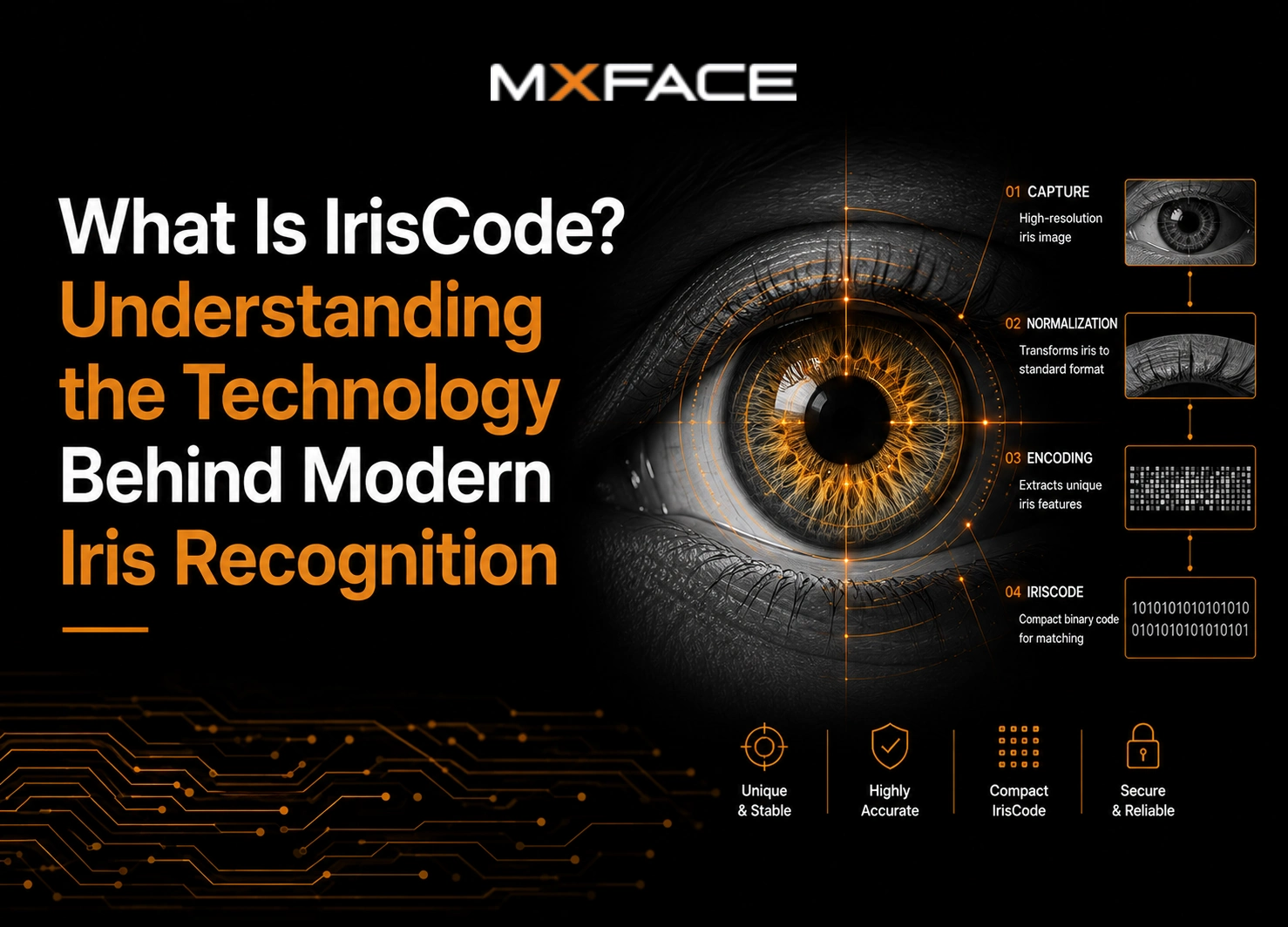
Step 1 — Image Acquisition
A near-infrared (NIR) camera captures a high-resolution image of the iris. NIR light is used because it penetrates the melanin in darker irises, revealing the full texture beneath something visible light can't always achieve. This is why iris recognition works reliably regardless of eye color.
Step 2 — Iris Segmentation
The system isolates the iris region from the rest of the image separating it from the pupil, sclera (the white of the eye), and any obstructions like eyelids or eyelashes. This step uses edge detection algorithms and active contour models. It's computationally intensive, and how well a system handles imperfect segmentation largely determines its real-world accuracy.
Step 3 — Feature Extraction and IrisCode Generation
This is where real engineering lives. The isolated iris texture is processed using 2D Gabor wavelets (or similar techniques) to encode the phase information of the iris pattern into a compact binary string typically 2,048 bits known as an IrisCode. This code is what actually gets compared during matching.
Step 4 — Matching via Hamming Distance
Two IrisCodes are compared using Hamming distance; it's a measure of how many bits differ between them. A Hamming distance below a set threshold (typically 0.32) indicates a match. What makes this approach elegant is its speed: comparing two 2,048-bit codes takes microseconds, enabling real-time authentication even across massive enrolled databases.
A well-implemented iris recognition pipeline can process, encode, and match an iris in under 500 milliseconds fast enough to feel instant to the user, robust enough to be trusted at a border crossing.
Modern systems also incorporate liveness detection using techniques like pupil dilation response to light or multispectral imaging to ensure the eye being scanned belongs to a living person, not a photograph or artificial replica.
How Businesses Are Actually Leveraging This
Border Control & Immigration
At high-volume international airports, the bottleneck isn't the number of officers, it's the speed of verification. Iris-based e-gates now process passengers in 3–5 seconds per person, compared to 30–60 seconds for manual document checks. More importantly, the system cross-references iris data against watchlists and enrolled traveler databases in real time. The result: faster throughput, fewer human errors, and a significantly harder system to game.
Healthcare & Patient Identity
Hospitals face a rarely-discussed but serious problem: patient misidentification. Wrong-patient errors in clinical settings contribute to thousands of preventable adverse events each year. Iris recognition addresses this without asking a sedated or disoriented patient to produce a card or recall a PIN. Enrollment happens once; authentication happens in under a second at any point of care and because it's contactless, there's no hygiene compromise in sterile environments.
Financial Services & Fraud Prevention
Banks and fintech companies are integrating iris biometric authentication at two critical touchpoints: high-value transaction approval and new account onboarding. The logic is straightforward, if someone is authorizing a $200,000 wire transfer, a password isn't sufficient verification. Iris confirmation ties the action to a specific biological identity, creating an audit trail that's almost impossible to repudiate.
Enterprise Access Control
Physical security in data centers, R&D facilities, and government buildings has long relied on keycards which get lost, shared, and cloned. Iris recognition eliminates the credential entirely. Access is tied to the person, not an object they carry. And because iris patterns don't change over time, there's no need to re-enroll users or issue renewals.
Workforce Management & Attendance
In large manufacturing plants and field operations, buddy punching where one employee clocks in for another costs companies an estimated 2.2% of gross payroll annually. Iris-based time and attendance systems make this impossible. Each clock-in is biometrically tied to the individual, creating accurate records without adding friction to the process.
The Real Challenge: Integrating It Without Starting From Scratch
Here's where many organizations hit a wall. The technology works. The use case is clear. But deploying iris recognition into an existing system whether that's an HR platform, an access control framework, or a customer-facing app is rarely straightforward.
Common integration pain points include:
- · Building iris capture and processing pipelines from scratch requires deep computer vision expertise
- · Matching at scale (millions of records) demands optimized indexing and retrieval architecture
- · Compliance requirements around biometric data storage and deletion vary by region and industry
- · Hardware compatibility of different iris sensors return different image formats and resolutions
- · Liveness detection needs to be embedded early in the pipeline, not bolted on later
Most businesses don't have and shouldn't need a team of computer vision engineers to solve these problems internally. The smarter path is building on infrastructure that's already solved them.
Where Purpose-Built APIs Change the Equation
This is where the architecture conversation gets practical. Rather than building iris recognition pipelines in-house, a growing number of businesses are integrating via API accessing a fully developed matching engine, feature extraction layer, and compliance framework through a few API calls.
MXFace.ai's Iris Recognition API is built specifically for this kind of deployment. The API handles the heavy lifting segmentation, IrisCode generation, high-speed matching — so development teams can focus on the business logic rather than the biometric infrastructure.
A few things worth noting about how it's built:- · No biometric data is retained post-processing iris templates are deleted automatically, keeping deployments compliant with GDPR, HIPAA, and similar frameworks
- · The SDK supports integration with leading iris sensors including the MATISX dual iris scanner and MIS100V2, reducing hardware compatibility work significantly
- · Real-time matching is designed to handle enterprise-scale datasets without degrading latency
- · The API is documented for straightforward developer onboarding — teams typically integrate and test within days, not weeks
What this means in practice: a bank can add iris-based transaction confirmation to its existing mobile app. A hospital can embed patient iris verification into its EHR system. An airport can connect to an existing immigration database. The biometric complexity is abstracted away; the business outcome isn't.
The best biometric integrations are the ones users never think about. They just work fast, accurately, and invisibly.
The Bigger Picture
Iris recognition isn't a feature. It's infrastructure. As organizations move toward zero-trust security models and friction-free user experiences simultaneously, the biometric layer becomes one of the most important architectural decisions they'll make.
The technology has matured. The market has validated it. Tooling like APIs, SDKs, compatible hardware exists to deploy it without a multi-year R&D investment. What's left is a decision about when, not whether.
For businesses serious about identity security, the answer is increasingly: sooner than you think.
Want to see how it fits your stack?
Explore the MXFace.ai Iris Recognition API and SDK - start your free trial and have it running in your environment within the week.