What is IrisCode? Understanding the Technology Behind Modern Iris Recognition
Iris recognition is one of the most technically sophisticated biometric identification technologies used in modern identity verification and authentication systems. Unlike conventional image-based identification methods that primarily analyze visible facial characteristics or fingerprint ridge patterns, iris recognition examines the complex and highly distinctive texture of the human iris. At the center of many iris recognition architectures is a compact biometric representation known as the IrisCode.
IrisCode converts the visual information contained within an iris image into a structured binary representation that can be efficiently compared with other iris templates. This transformation allows biometric systems to perform rapid and reliable matching without treating the original eye image as the primary comparison object.
The concept of IrisCode is closely associated with modern iris recognition research and has influenced the architecture of large-scale biometric systems. By transforming detailed iris texture into a mathematical representation, IrisCode enables systems to compare biometric patterns using computationally efficient similarity measurements.
For organizations developing identity verification, border management, access control, digital identity, authentication, and high-assurance security solutions, understanding IrisCode is important because it explains how raw iris imagery can become an actionable biometric template.
Platforms such as MxFace.ai extend modern biometric infrastructure across multiple recognition technologies, including iris recognition, face recognition, fingerprint recognition, and liveness-related capabilities. These technologies can be integrated into applications that require automated biometric identification and verification.
What Is IrisCode?
IrisCode is a digital representation of the distinctive texture patterns present in an individual's iris. Instead of comparing two eye images directly at the pixel level, an iris recognition system processes the iris and encodes its relevant texture information into a binary biometric representation.
The resulting code can be used by a matching algorithm to determine how closely two iris samples correspond.
In simplified terms, the process can be represented as:
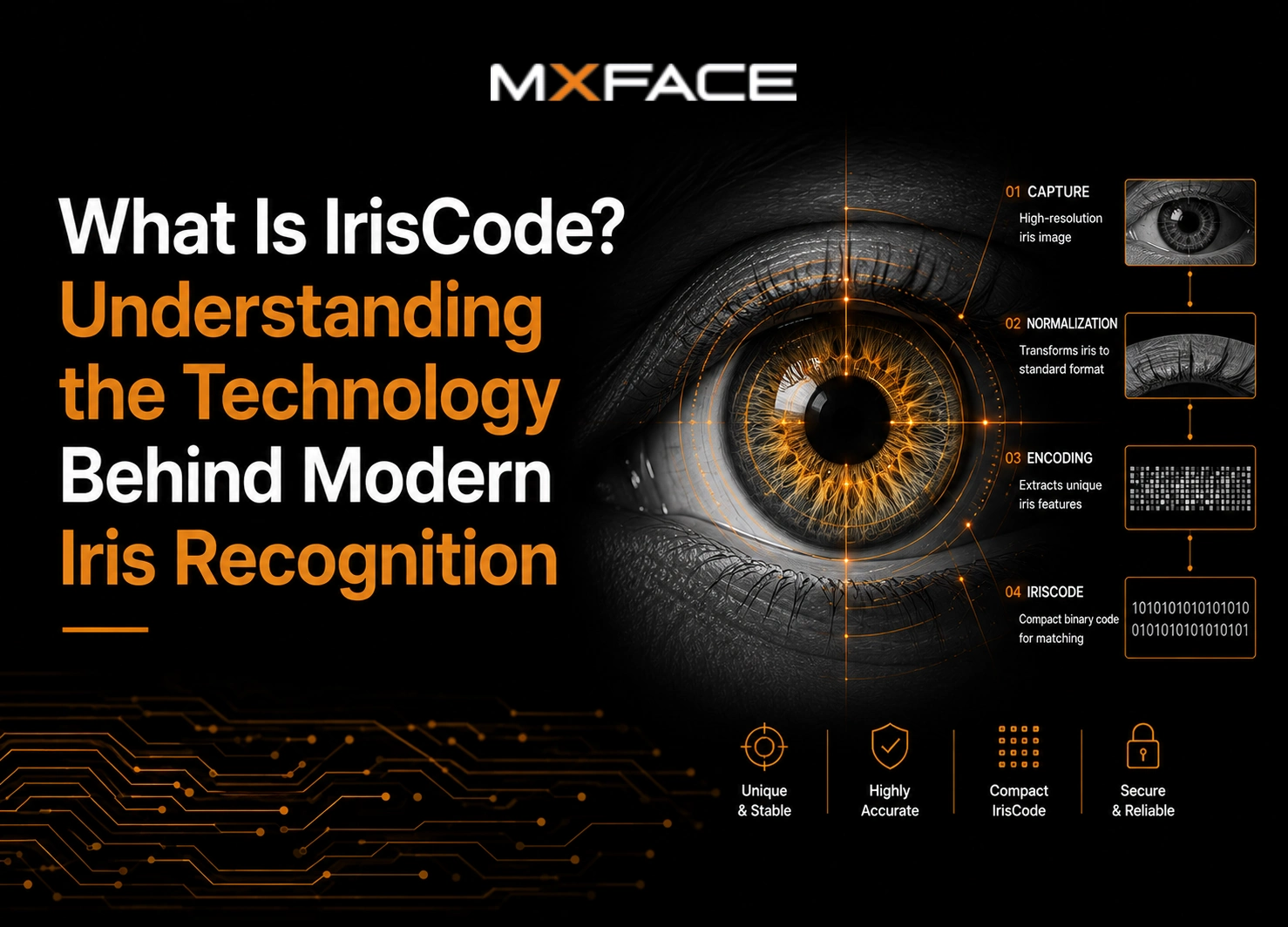
Iris Image → Iris Segmentation → Normalization → Texture Analysis → Feature Encoding → IrisCode → Matching
The important characteristic of IrisCode is that it represents biometric information in a compact computational form. The representation captures patterns that are sufficiently distinctive for biometric comparison while allowing matching operations to be performed efficiently.
An IrisCode should therefore not be understood as a conventional password, identification number, or simple image hash. It is a biometric representation generated from the underlying structural and textural characteristics of the iris.
Why Is the Iris Suitable for Biometric Recognition?
The human iris contains intricate patterns formed by crypts, furrows, rings, freckles, and other textural structures. These patterns provide a highly detailed biometric signal that can be captured and computationally analyzed.
One important property of iris recognition is the complexity of the texture information available for feature extraction. The system can use variations in local iris texture to create a representation that distinguishes one enrolled iris from another.
Iris recognition also has the advantage of being contactless. Unlike fingerprint authentication, which generally requires interaction with a sensor, iris recognition can acquire biometric information through a camera-based imaging system.
However, contactless capture introduces its own engineering requirements. Camera resolution, focus, illumination, eye positioning, segmentation accuracy, reflections, eyelid occlusion, and image quality can all affect the quality of the biometric sample.
Consequently, a reliable iris recognition system requires considerably more than simply capturing an image of an eye.
How IrisCode Works
The generation of IrisCode begins with an iris image captured by an appropriate imaging sensor. The system must first determine where the iris is located within the image and separate the usable iris region from surrounding structures.
This process generally involves several computational stages.
1. Iris Image Acquisition
The first stage is acquiring an image containing the user's eye. Depending on the application, an iris sensor or camera system may capture the eye under controlled or semi-controlled illumination.
The acquisition system should provide sufficient resolution and contrast to preserve the fine textural characteristics required for subsequent feature extraction.
2. Iris Localization and Segmentation
After image acquisition, the system identifies the iris boundaries. The iris must be separated from surrounding regions such as the sclera, eyelids, eyelashes, skin, and pupil.
Segmentation is one of the most important stages because inaccurate boundaries can introduce non-iris information into the biometric representation.
The system generally attempts to determine the inner boundary around the pupil and the outer boundary around the iris. Occluded or unreliable regions may also need to be identified and excluded.
3. Iris Normalization
Iris images can differ because of changes in pupil dilation, camera distance, viewing geometry, and eye positioning. Directly comparing these images can therefore introduce unnecessary variation.
Normalization transforms the segmented iris region into a standardized coordinate representation. This allows the system to analyze corresponding iris regions more consistently across different captures.
One well-known conceptual approach is to transform the annular iris region into a normalized rectangular representation. This helps reduce geometric variation before feature extraction.
4. Texture Feature Extraction
Once the iris has been normalized, the recognition system analyzes its texture. Mathematical filters can be applied to identify local changes in intensity and spatial patterns within the iris.
Traditional iris recognition research has used filtering approaches capable of capturing texture information at different orientations and spatial scales.
The objective is to extract stable patterns while minimizing the effect of image noise, illumination differences, and other non-biometric variations.
5. Binary Encoding
The extracted texture information is converted into a binary representation. This representation forms the basis of the IrisCode.
Rather than storing every pixel of the original eye image as the matching representation, the system encodes relevant texture responses into a compact structure.
The encoding process can also produce a corresponding mask indicating which portions of the representation are reliable and which regions should be ignored during matching.
6. Iris Matching
During authentication or identification, the newly generated IrisCode is compared with one or more enrolled templates.
A similarity or distance measure is calculated between the representations. In traditional IrisCode systems, Hamming distance has been widely associated with binary template comparison.
Conceptually, the comparison can be expressed as:
Hamming Distance = Number of Differing Valid Bits ÷ Number of Compared Valid Bits
A lower distance generally indicates greater similarity between the compared iris representations, although the exact decision mechanism depends on the implementation and threshold configuration.
IrisCode Generation Workflow
The following workflow illustrates how a captured iris image can be transformed into a biometric representation and ultimately used for authentication or identification.
| Stage | Processing Operation | Output |
|---|---|---|
| Image Acquisition | Capture high-quality eye image using an iris imaging sensor | Raw Iris Image |
| Iris Detection | Locate the eye and identify the usable iris region | Detected Iris Region |
| Segmentation | Separate iris boundaries from pupil, sclera, eyelids, and eyelashes | Segmented Iris |
| Quality Assessment | Evaluate focus, illumination, occlusion, resolution, and usable iris area | Quality Score / Valid Sample |
| Normalization | Transform the iris region into a standardized representation | Normalized Iris Pattern |
| Feature Extraction | Analyze local texture using mathematical filtering and feature-processing techniques | Texture Features |
| Encoding | Convert relevant texture information into a binary biometric representation | IrisCode + Mask |
| Matching | Compare the generated representation against enrolled iris templates | Similarity / Distance Score |
| Decision | Evaluate the score against application-specific policies and thresholds | Accept / Reject / Identify |
What Information Does an IrisCode Contain?
An IrisCode primarily represents encoded information derived from iris texture rather than preserving the complete original eye image as the matching representation.
The binary structure can capture responses produced by mathematical filters operating on the normalized iris texture. Different portions of the iris generate different patterns within the representation.
A corresponding mask can be used to identify unreliable areas. For example, eyelashes, eyelids, reflections, or segmentation errors may cause portions of the captured iris to be unsuitable for comparison.
During matching, the system can therefore compare valid portions of the representations while excluding masked regions.
This separation between biometric information and invalid image regions is important because real-world iris captures are rarely perfect.
Understanding Hamming Distance in Iris Recognition
Hamming distance is a commonly discussed similarity measurement for binary biometric representations such as IrisCode.
It measures the proportion of corresponding bits that differ between two binary strings, subject to the valid-region mask.
For example, if two IrisCode representations have a large number of matching valid bits, their normalized Hamming distance will generally be lower. If many valid bits differ, the distance will be higher.
A simplified representation is:
Lower Distance → Greater Pattern Similarity
Higher Distance → Lower Pattern Similarity
The actual acceptance threshold should not be assumed to be universal. Production biometric systems must establish thresholds based on their specific algorithm, sensor, population, operating conditions, security requirements, and desired false-match and false-non-match trade-offs.
IrisCode and Template Matching
Biometric authentication commonly involves comparing a newly captured sample with an enrolled biometric reference.
During enrollment, the iris image is processed and transformed into a biometric template. During subsequent authentication, another iris sample is processed through the same or compatible pipeline.
The system then calculates a comparison score between the newly generated representation and the stored reference.
This creates a fundamental distinction between enrollment and verification.
Enrollment establishes the reference representation associated with an identity. Verification evaluates whether a newly presented biometric sample sufficiently corresponds to that reference.
In identification applications, the generated representation can instead be searched against a collection of enrolled templates to determine the most likely corresponding identity.
1:1 Verification vs. 1:N Identification
Iris recognition can support different biometric operating modes.
1:1 Verification
In 1:1 verification, the system already knows the claimed identity and compares the presented iris against the corresponding enrolled template.
The question is:
"Does this iris sample belong to the claimed identity?"
This approach is commonly associated with authentication and identity verification.
1:N Identification
In 1:N identification, the system compares the presented biometric representation against multiple enrolled templates.
The question becomes:
"Which enrolled identity corresponds most closely to this iris sample?"
This requires efficient template indexing, matching infrastructure, search optimization, and carefully controlled decision thresholds, especially when the enrolled population becomes large.
Why IrisCode Is Computationally Important
A major advantage of a compact biometric representation is computational efficiency.
Comparing raw high-resolution images can require significant processing and may be sensitive to variations that are not directly relevant to identity. A structured binary representation allows the matching engine to focus on encoded biometric information.
Binary comparisons can also be implemented efficiently using low-level computational operations. This characteristic becomes increasingly important in large-scale identification systems where many biometric templates may need to be evaluated.
However, computational efficiency does not remove the need for robust system engineering. A high-performance matching engine cannot compensate for poor image acquisition, inaccurate segmentation, weak template protection, or poorly calibrated decision thresholds.
The Importance of Iris Image Quality
IrisCode generation depends directly on the quality of the source image.
If the captured eye image is blurred, excessively illuminated, poorly focused, partially occluded, or incorrectly segmented, the resulting representation may contain unreliable information.
Several image characteristics can influence iris recognition performance, including:
- ➜ Image resolution
- ➜ Focus quality
- ➜ Illumination consistency
- ➜ Eye positioning
- ➜ Motion blur
- ➜ Eyelid and eyelash occlusion
- ➜ Specular reflections
- ➜ Pupil and iris segmentation accuracy
- ➜ Usable iris area
A production-grade system can therefore incorporate iris quality assessment before template generation or matching.
If the sample does not satisfy the required quality criteria, the system may request another capture rather than generating a low-quality biometric template.
IrisCode and Rotation Compensation
Human eyes can rotate slightly during image acquisition. Even small rotational differences can affect the alignment of corresponding iris patterns.
Iris recognition systems can therefore incorporate rotational compensation during matching. The comparison process may evaluate multiple relative orientations to determine whether the representations align more closely under a small rotational adjustment.
This is particularly important because biometric matching should distinguish genuine identity variation from changes caused by the acquisition process.
Normalization and rotational compensation together help create greater consistency between enrollment and verification samples.
IrisCode vs. Raw Iris Image
An important distinction exists between the original iris image and the IrisCode generated from it.
The raw iris image contains a large amount of visual information, including biometric and non-biometric elements. The IrisCode is a derived representation intended to capture relevant iris texture information for biometric comparison.
This distinction provides several architectural advantages.
- ➜ The biometric matcher can operate on a structured representation.
- ➜ Matching can be computationally efficient.
- ➜ Invalid regions can be represented through masks.
- ➜ The system can reduce dependence on direct pixel-level comparison.
- ➜ Template storage can be separated conceptually from original image storage.
Nevertheless, an IrisCode should still be treated as sensitive biometric information. Derived biometric templates can have security and privacy implications and should be protected using appropriate technical and organizational controls.
Security Considerations for IrisCode
Biometric systems require security controls across the entire processing lifecycle. IrisCode is not a conventional credential that can simply be replaced like a password if compromised.
Organizations should therefore consider secure enrollment, protected template storage, encrypted communication, controlled access, audit logging, secure APIs, data minimization, and appropriate retention policies.
Presentation attacks are another important consideration. An attacker may attempt to present an artificial or manipulated biometric sample to the acquisition system.
For high-assurance applications, iris recognition should therefore be evaluated as part of a broader biometric security architecture that can incorporate presentation-attack detection, sensor controls, environmental protections, and application-level risk management.
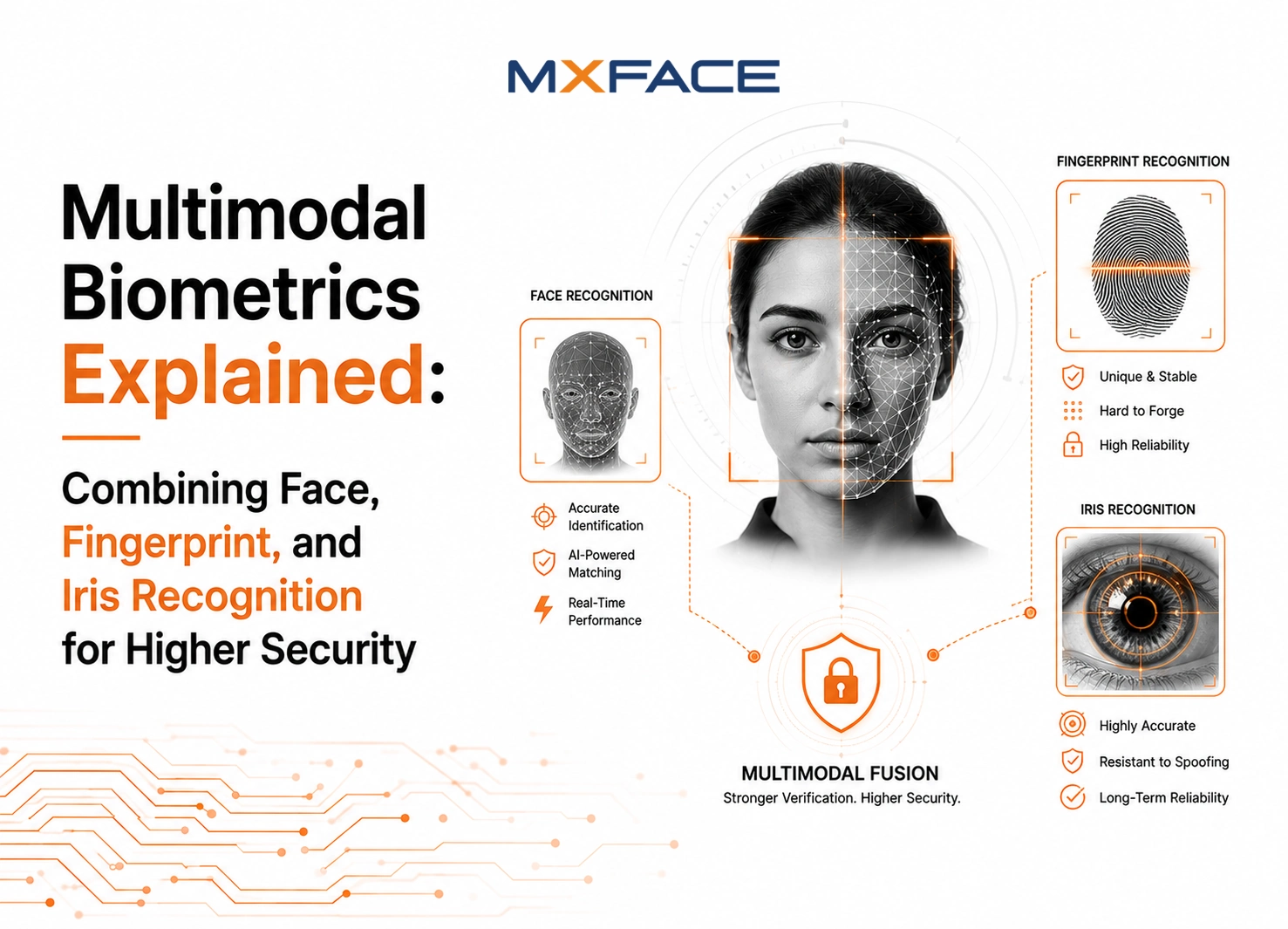
IrisCode in Multimodal Biometrics
Iris recognition does not necessarily need to operate as a standalone biometric modality. It can be combined with other biometric technologies in a multimodal architecture.
For example, an application could combine:
- ➜ Face recognition
- ➜ Fingerprint recognition
- ➜ Iris recognition
Each modality can generate its own biometric evidence before a higher-level fusion engine evaluates the combined results.
A conceptual architecture could be:
Face Score + Fingerprint Score + Iris Score → Score Normalization → Fusion → Authentication Decision
This approach can provide multiple sources of biometric evidence. If one modality produces a weak result because of environmental or acquisition conditions, the system may be able to use additional evidence according to its configured policy.
Platforms such as MxFace.ai are relevant to this architecture because modern biometric applications can require multiple recognition capabilities rather than relying exclusively on one modality.
Role of MxFace.ai in Modern Iris Recognition
MxFace.ai provides biometric technology designed to support modern identity and authentication workflows, including iris recognition alongside other biometric capabilities.
For developers and enterprises, this type of biometric infrastructure can simplify the integration of recognition capabilities into applications that require automated identity processing.
An application using iris recognition may incorporate biometric processing into workflows such as identity verification, access control, authentication, workforce systems, secure facilities, digital onboarding, and other high-assurance environments.
Rather than developing every biometric-processing component independently, organizations can integrate biometric APIs and SDK-based capabilities into their existing application architecture.
The exact implementation can vary depending on the required modality, sensor, deployment environment, security model, and application workflow.
Applications of Iris Recognition
The underlying principles of IrisCode can support a broad range of biometric applications.
Identity Verification
Iris recognition can be used to compare a newly captured iris sample with an enrolled biometric template to establish whether the presented individual corresponds to a claimed identity.
Access Control
High-security facilities can use iris recognition as one component of an access-control system where stronger identity assurance is required.
Digital Identity
Iris biometrics can contribute to digital identity architectures that require reliable biometric verification alongside other identity attributes and authentication mechanisms.
Border and Government Systems
Large-scale identity programs can use iris recognition where accurate biometric identification and efficient template comparison are required.
Enterprise Authentication
Organizations can incorporate iris recognition into authentication systems for controlled environments, privileged access, or other workflows where biometric assurance is important.
Challenges in Modern Iris Recognition
Although iris recognition provides a powerful biometric signal, implementation still presents several technical challenges.
Capture Conditions
Camera positioning, focus, illumination, and user cooperation can influence sample quality.
Segmentation Accuracy
Incorrectly identifying the pupil and iris boundaries can introduce non-iris regions into the biometric representation.
Occlusion
Eyelids, eyelashes, and reflections can obscure portions of the iris and reduce the amount of usable biometric information.
Sensor Compatibility
Different imaging devices can produce different image characteristics. A biometric algorithm should therefore be evaluated under the sensor conditions in which it will operate.
Template Protection
Biometric templates must be protected because biometric characteristics cannot simply be reissued in the same way as passwords.
User Experience
High-security systems must balance biometric assurance with capture speed, user convenience, and operational requirements.
Future of IrisCode and Iris Recognition
Iris recognition continues to evolve alongside improvements in imaging hardware, computer vision, machine learning, biometric algorithms, and edge computing.
Modern systems can increasingly incorporate automated quality assessment, advanced segmentation, robust feature extraction, adaptive matching, and more sophisticated presentation-attack detection mechanisms.
Machine learning can also contribute to different stages of biometric processing, although the underlying objective remains the same: extract stable identity-related information while minimizing irrelevant variation.
Future biometric architectures are also likely to become increasingly multimodal. Instead of treating face, fingerprint, and iris recognition as isolated technologies, organizations can combine their outputs within risk-aware identity platforms.
This creates opportunities for adaptive authentication in which the system determines which biometric evidence is necessary based on transaction risk, environmental conditions, device capabilities, and organizational policies.
Conclusion
IrisCode represents a fundamental concept in modern iris recognition: transforming the complex texture of the human iris into a compact, structured biometric representation that can be efficiently compared during authentication and identification.
The complete process involves significantly more than generating a binary code. A reliable iris recognition system requires high-quality image acquisition, iris localization, segmentation, quality assessment, normalization, texture analysis, feature encoding, template generation, matching, threshold management, and secure decision-making.
The strength of IrisCode comes from its ability to represent distinctive iris texture in a computationally efficient form. Matching techniques such as Hamming-distance-based comparison can then evaluate the similarity between biometric representations while using masks to exclude unreliable regions.
However, IrisCode is only one component of a complete biometric architecture. Security, privacy, presentation-attack detection, sensor reliability, image quality, template protection, and operational performance must all be considered when deploying iris recognition in real-world environments.
For organizations developing modern identity verification and authentication solutions, MxFace.ai provides a broader biometric technology foundation that can incorporate iris recognition alongside face recognition, fingerprint recognition, and liveness-related capabilities.
As biometric systems continue to evolve, the future will increasingly depend on intelligent biometric architectures that can process multiple sources of identity evidence securely and efficiently. Understanding technologies such as IrisCode provides an important technical foundation for building these next-generation biometric systems.