Multimodal Biometrics Explained: Combining Face, Fingerprint and Iris Recognition for Higher Security

Biometric authentication has evolved significantly from systems that rely on a single physiological characteristic. Facial features, fingerprint ridge patterns, and iris structures each provide a distinct biometric signal, but every modality also has environmental, operational, and sensor-specific limitations. Multimodal biometrics addresses this limitation by combining two or more biometric modalities within a unified identity-verification architecture.
Instead of depending exclusively on a face image, fingerprint scan, or iris capture, a multimodal system can evaluate multiple independent biometric characteristics and use their combined evidence to make a stronger authentication or identification decision.
The concept is not simply about collecting more biometric data. A properly engineered multimodal biometric architecture requires modality-specific acquisition, quality assessment, feature extraction, template generation, matching, score normalization, fusion, thresholding, and decision logic. NIST recognizes face, fingerprint, iris, and multimodal biometrics as distinct areas of biometric research and evaluation.
For organizations developing identity verification, access control, digital onboarding, financial authentication, enterprise security, and other high-assurance applications, this architecture can provide a more resilient authentication framework.
Platforms such as MxFace.ai bring multiple biometric capabilities, including face recognition, fingerprint recognition, iris recognition, liveness detection, and related biometric APIs and SDKs, into a developer-oriented ecosystem.
This article explains how multimodal biometrics works, why combining face, fingerprint, and iris recognition can strengthen biometric security, and how MxFace.ai can fit into modern multimodal identity architectures.
What Is Multimodal Biometrics?
Multimodal biometrics refers to a biometric recognition architecture that uses multiple biometric modalities to establish or verify an individual's identity.
A unimodal system may rely on only one characteristic:
- Face
- Fingerprint
- Iris
- Voice
- Palmprint
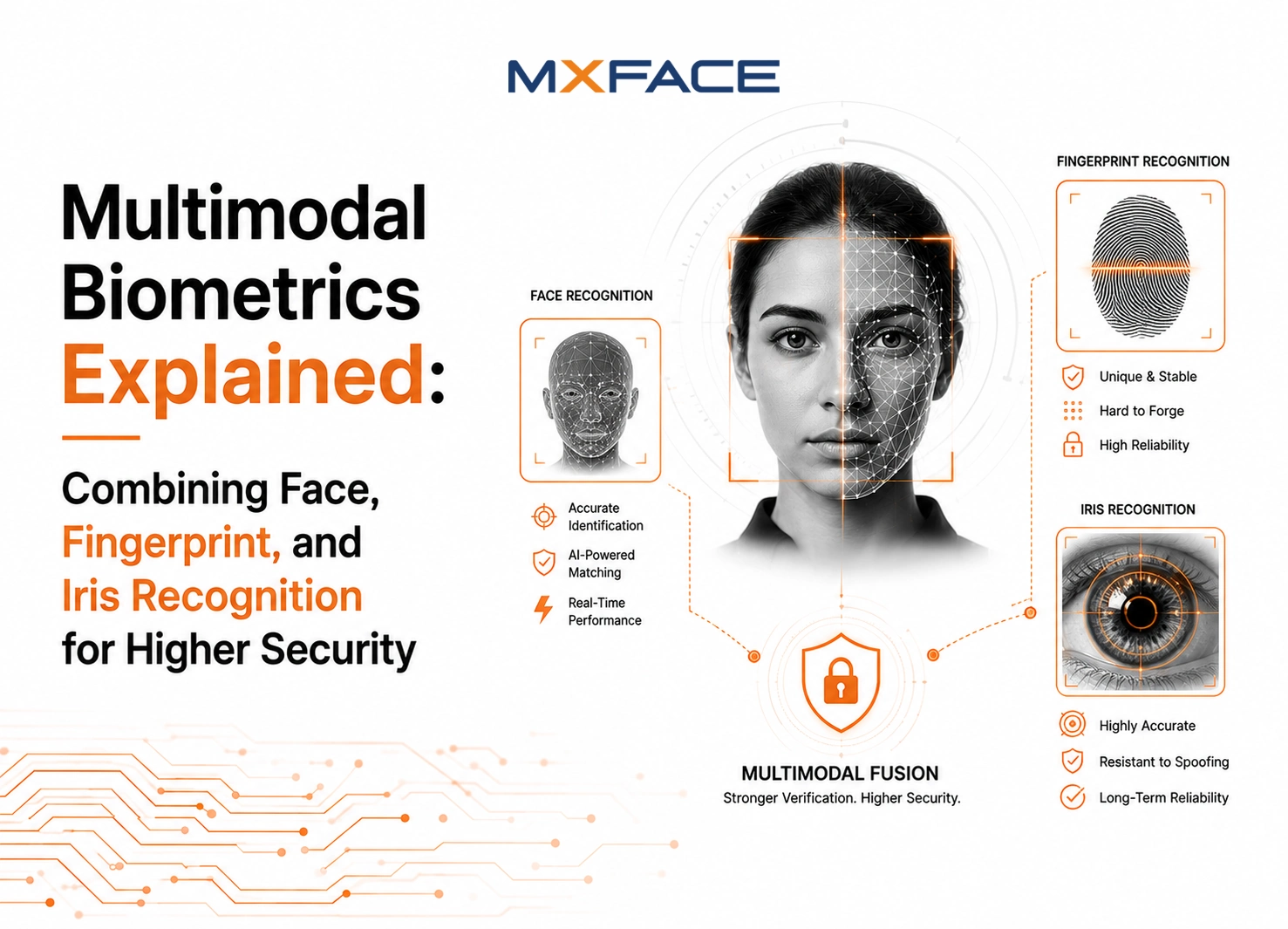
A multimodal system combines multiple characteristics, such as face + fingerprint, face + iris, or face + fingerprint + iris.
The fundamental advantage comes from biometric diversity.
Each modality observes a different physiological characteristic. Face recognition analyzes facial structure and appearance, fingerprint recognition analyzes distinctive ridge and minutiae patterns, while iris recognition analyzes the complex texture of the iris.
NIST describes biometrics as the measurement of physiological characteristics including fingerprints, iris patterns, and facial features, while also explicitly including multimodal biometrics within its research scope.
This diversity means that an environmental or operational problem affecting one modality does not necessarily affect the others in the same way.
For example, poor illumination can affect facial image acquisition, while a damaged or contaminated fingerprint sensor can affect fingerprint capture. A multimodal architecture can therefore introduce additional evidence rather than relying completely on the affected modality. NIST research has specifically examined multimodal systems as a way of improving flexibility and reliability compared with single-modality approaches.
Why Combine Face, Fingerprint and Iris Recognition?
The primary reason for combining biometric modalities is to increase the amount and diversity of evidence available during authentication or identification.
Face recognition is contactless and convenient. It can operate through cameras already integrated into smartphones, kiosks, access-control terminals, and identity-verification systems.
Fingerprint recognition provides highly distinctive ridge-pattern information and has long been used for authentication and identification applications.
Iris recognition analyzes the intricate texture of the iris and can provide another independent biometric signal.
When these modalities are combined, the system does not have to rely entirely on one source of biometric evidence.
Conceptually:
| Biometric Modality | Primary Signal | Typical Strength | Potential Challenge |
|---|---|---|---|
| Face Recognition | Facial structure and appearance | Contactless and convenient | Lighting, pose, occlusion, presentation attacks |
| Fingerprint Recognition | Ridge patterns and minutiae | Highly distinctive and mature | Sensor quality, finger condition, capture requirements |
| Iris Recognition | Iris texture | Highly distinctive and contactless | Capture alignment, camera requirements, environmental conditions |
| Multimodal Biometrics | Combined biometric evidence | Increased evidence diversity and resilience | More complex acquisition, fusion, and system architecture |
The objective is therefore not merely to use three technologies simultaneously. The objective is to construct a decision architecture in which independent biometric evidence can be combined intelligently.
Face Recognition as a Biometric Modality
Face recognition is often the most convenient modality for user-facing authentication because it can be captured without physical contact.
A typical facial biometric pipeline begins with image acquisition and proceeds through face detection, quality assessment, preprocessing, feature extraction, representation generation, and comparison.
The resulting representation can then be compared against a reference representation for 1:1 verification or searched against a registered collection for 1:N identification.
MxFace.ai provides facial capabilities including Face Detection, Face Comparing, Face Search, Face Landmark Detection, and Face Recognition. Its platform also provides liveness-related capabilities designed to support biometric security workflows.
This makes face recognition particularly useful as the front-facing modality in multimodal applications.
For example, a digital onboarding application might initially capture a user's face and perform facial verification. For a higher-assurance transaction, the same workflow could request a fingerprint or iris factor before approving the transaction.
Fingerprint Recognition as a Biometric Modality
Fingerprint recognition operates on the distinctive patterns formed by ridges and valleys on an individual's fingertip.
A fingerprint-processing system generally performs several computational stages, including image acquisition, segmentation, enhancement, ridge analysis, feature extraction, template generation, and biometric matching.
Instead of treating a fingerprint as an ordinary image, the biometric system extracts structured information that can be used for comparison.
Fingerprint recognition can therefore provide an additional biometric factor in applications where stronger identity assurance is required.
MxFace.ai provides fingerprint recognition capabilities designed to analyze fingerprint patterns and generate biometric information for identification and authentication workflows. The platform describes fingerprint recognition as one of its biometric recognition capabilities and also supports fingerprint-oriented SDK and device integration.
The presence of a fingerprint modality alongside facial recognition can reduce dependency on facial evidence alone.
Iris Recognition as a Biometric Modality
Iris recognition focuses on the highly detailed texture patterns present within the iris.
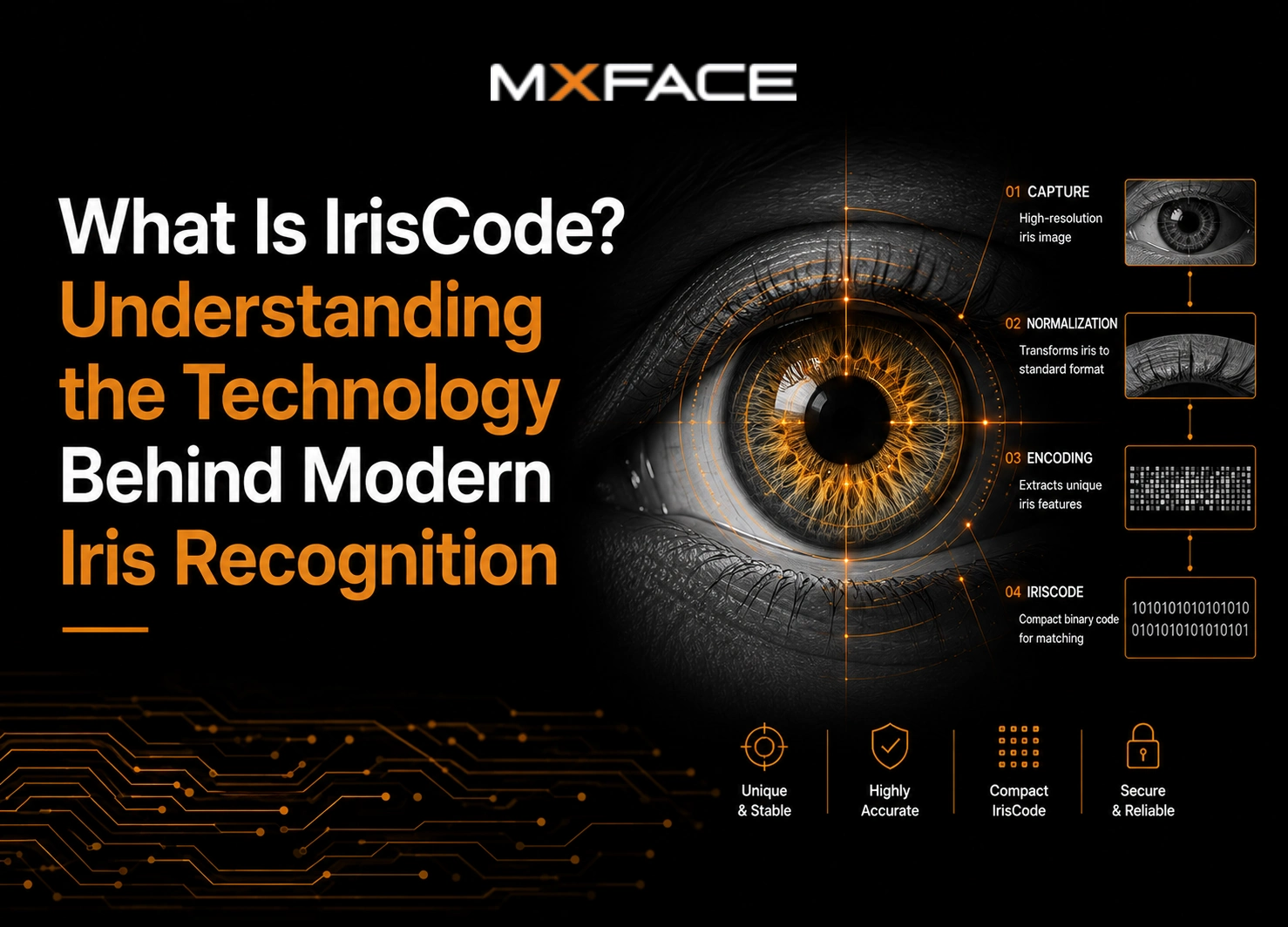
The iris contains complex visual structures that can be processed to generate a biometric representation. A typical iris-recognition pipeline involves eye acquisition, iris localization, segmentation, normalization, feature extraction, and matching.
Iris recognition can be particularly valuable in environments where higher-assurance biometric authentication is required.
MxFace.ai includes iris recognition within its biometric recognition platform and provides support for iris-oriented biometric devices.
When combined with face and fingerprint recognition, iris recognition introduces another independent biometric signal into the authentication architecture.
The Architecture of a Multimodal Biometric System
A multimodal system requires considerably more architecture than simply placing three biometric APIs next to one another.
Each modality typically has its own acquisition and processing pipeline.
The outputs then need to be brought into a common decision architecture.
Workflow 1: Multimodal Enrollment and Authentication
| Stage | Face Pipeline | Fingerprint Pipeline | Iris Pipeline |
|---|---|---|---|
| 1. Capture | Facial image acquired | Fingerprint captured | Iris image acquired |
| 2. Quality Assessment | Face quality evaluated | Fingerprint quality evaluated | Iris capture quality evaluated |
| 3. Preprocessing | Face alignment / normalization | Ridge enhancement / segmentation | Iris segmentation / normalization |
| 4. Feature Extraction | Facial features extracted | Ridge/minutiae features extracted | Iris texture features extracted |
| 5. Template Generation | Face biometric template | Fingerprint template | Iris biometric template |
| 6. Matching | Face-to-template comparison | Fingerprint-to-template comparison | Iris-to-template comparison |
| 7. Score Generation | Face matching score | Fingerprint matching score | Iris matching score |
| 8. Score Fusion | Combined with other scores | Combined with other scores | Combined with other scores |
| 9. Decision | Multimodal authentication decision | Multimodal authentication decision | Multimodal authentication decision |
The important architectural concept is that each modality can remain specialized during the initial processing stages.
Face processing should not be forced into the same feature-extraction mechanism as fingerprint processing. Fingerprint and iris images have fundamentally different structures, sensor characteristics, and preprocessing requirements.
Instead, modality-specific algorithms generate modality-specific evidence.
That evidence can subsequently be normalized and fused at a higher level.
What Is Biometric Fusion?
Biometric fusion is the process of combining information generated by multiple biometric matchers.
There are several possible fusion levels.
Sensor-Level Fusion
Sensor-level fusion combines information before the individual biometric features are fully extracted. This approach can be technically complex because different biometric sensors generate fundamentally different data structures.
Feature-Level Fusion
Feature-level fusion combines extracted biometric features before matching. This can provide a rich representation, but dimensionality, normalization, compatibility, and privacy considerations become important.
Score-Level Fusion
Score-level fusion combines the matching scores generated independently by different biometric systems.
For example:
Face Score + Fingerprint Score + Iris Score → Normalized Combined Score
Score-level fusion is particularly attractive because each modality can maintain its own specialized matcher while the overall system combines its outputs.
NIST research has evaluated score-level fusion techniques for face and fingerprint systems and found significant performance improvements in the studied configurations.
Decision-Level Fusion
Decision-level fusion combines final decisions from individual biometric systems.
For example:
Face = Accept
Fingerprint = Accept
Iris = Accept
→ Multimodal Decision = Accept
This approach is relatively straightforward but can discard useful information contained in the original matching scores.
Why Score Fusion Is Important
A multimodal biometric system should not necessarily treat every modality as an equal binary signal.
Suppose a face matcher produces a strong similarity score, while the fingerprint matcher produces a moderate score and the iris matcher produces a strong score.
Converting each result immediately into a simple "yes" or "no" can discard useful information.
Instead, a fusion layer can normalize and combine the scores according to a defined decision strategy.
Conceptually:
Combined Evidence = f(Face Score, Fingerprint Score, Iris Score)
The fusion function may incorporate weighting, normalization, thresholds, likelihood-based methods, statistical models, or other application-specific mechanisms.
The correct fusion strategy depends on the biometric architecture, population, sensor characteristics, security requirements, and operating environment.
Multimodal Biometrics Does Not Automatically Mean Three-Factor Authentication
This distinction is important.
Multimodal biometrics and multi-factor authentication are related but not identical concepts.
Multimodal biometrics combines multiple biometric characteristics.
Multi-factor authentication combines independent authentication factors, which can include:
- Something you know
- Something you have
- Something you are
Face, fingerprint, and iris are all examples of "something you are."
Therefore, using all three together creates a multimodal biometric system, but it does not necessarily constitute three independent authentication factors in the traditional authentication-factor sense.
A system combining face recognition with a device credential and a biometric factor could represent a broader multi-factor architecture.
Workflow 2: Multimodal Verification and Decision Fusion
| Input | Processing | Biometric Result | Fusion Layer |
|---|---|---|---|
| Face Image | Detection → Quality Check → Feature Extraction → Matching | Face Score | ↓ |
| Fingerprint | Enhancement → Feature Extraction → Matching | Fingerprint Score | ↓ |
| Iris Image | Segmentation → Normalization → Feature Extraction → Matching | Iris Score | ↓ |
| — | Score Normalization | Normalized Scores | ↓ |
| — | Multimodal Fusion | Combined Confidence | ↓ |
| — | Threshold / Policy Evaluation | Accept / Reject / Retry | Final Decision |
This architecture illustrates why multimodal biometrics is fundamentally a systems-engineering problem.
The quality of the final decision depends not only on the accuracy of individual biometric algorithms but also on acquisition quality, score calibration, fusion methodology, threshold selection, failure handling, and operational conditions.
How MxFace.ai Fits Into Multimodal Biometrics
MxFace.ai is positioned around biometric AI infrastructure that includes face, fingerprint, iris, and liveness capabilities through APIs and SDKs.
This is particularly relevant for developers building multimodal identity architectures because different biometric capabilities can be integrated according to the application's security requirements.
For example, a high-security access-control application could use:
Face Recognition → Fingerprint Verification → Iris Verification → Access Decision
A digital identity workflow could instead use:
Face Capture → Liveness Detection → Face Verification → Additional Biometric Challenge
A critical point is that MxFace.ai capabilities can function as components within a broader application architecture rather than forcing developers to build every biometric-processing component independently.
The platform provides separate biometric capabilities, allowing application teams to select the modalities relevant to their specific requirements.
Multimodal Biometrics and Liveness Detection
Adding multiple biometric modalities does not eliminate presentation attacks.
A photograph, replayed video, fabricated fingerprint artifact, or other presentation attack can potentially target a biometric acquisition system.
Consequently, liveness and presentation-attack detection should be considered when designing high-assurance biometric systems.
NIST's current digital identity guidance specifies presentation-attack detection requirements for facial recognition and recommends PAD for iris and fingerprint modalities in applicable biometric systems.
For facial workflows, MxFace.ai provides passive and active liveness capabilities designed to help distinguish genuine users from spoofing attempts.
A more comprehensive architecture can therefore become:
Capture → Liveness / PAD → Quality Assessment → Feature Extraction → Matching → Fusion → Decision
This approach treats biometric security as a complete pipeline rather than simply selecting a highly accurate recognition model.
Why Image and Sensor Quality Still Matter
Multimodal architecture does not eliminate poor-quality biometric input.
If the face image is heavily blurred, the fingerprint is incomplete, or the iris capture is poorly aligned, the corresponding matcher may produce a weak or unreliable score.
This is why quality assessment should be performed independently for each modality.
A robust system can implement modality-specific quality thresholds and determine whether a particular biometric sample is suitable for matching.
For example:
- Face quality may consider pose, illumination, blur, occlusion, and image resolution.
- Fingerprint quality may consider ridge clarity, contrast, partial capture, and sensor conditions.
- Iris quality may consider segmentation, focus, illumination, occlusion, and usable iris area.
The system can then decide whether to accept the sample, request recapture, or continue using available modalities.
Multimodal Biometrics for Identity Verification
Identity verification is one of the most direct applications for multimodal biometrics.
During enrollment, multiple biometric characteristics can be associated with a single identity record.
During subsequent authentication, the system captures one or more biometric samples and compares them against the enrolled templates.
A higher-assurance workflow may require multiple modalities before granting access.
For example, an enterprise security system could use facial recognition for rapid initial verification and fingerprint or iris recognition for privileged-access confirmation.
This architecture can be especially useful when the consequences of unauthorized access are significant.
Multimodal Biometrics for Digital Onboarding
Digital onboarding frequently requires identity verification without physical interaction with a service representative.
Facial recognition is particularly useful because it can operate through a standard camera.
However, applications requiring stronger assurance may introduce additional biometric verification steps.
A conceptual onboarding architecture could include:
Identity Document → Face Capture → Liveness Detection → Face Verification → Additional Biometric Verification → Identity Decision
The exact implementation depends on regulatory requirements, risk models, identity-document infrastructure, and the application's authentication policy.
Multimodal Biometrics for Access Control
Physical and logical access-control systems can also benefit from multimodal biometric architectures.
A conventional system might rely on a single fingerprint or face match.
A higher-assurance environment could require multiple biometric signals before granting access.
For example:
Face + Fingerprint → Access Decision
or:
Face + Iris → High-Security Access
or:
Face + Fingerprint + Iris → Critical Access
The correct architecture depends on the security classification of the protected environment and the operational requirements of the organization.
Multimodal Biometrics and Scalability
Large-scale biometric systems introduce additional technical considerations.
An application may need to handle thousands, millions, or more enrolled biometric identities.
At this scale, template management, indexing, search performance, concurrency, database architecture, API throughput, and distributed processing become important.
The distinction between 1:1 verification and 1:N identification also becomes critical.
A 1:1 system asks:
"Does this biometric sample match this specific identity?"
A 1:N system asks:
"Which enrolled identity best corresponds to this biometric sample?"
Face Search capabilities from MxFace.ai are designed for scalable 1:N face-matching workflows, while other biometric modalities can be integrated according to the application's identity architecture.
Security Considerations Beyond Recognition Accuracy
A common mistake in biometric-system design is to evaluate security solely through recognition accuracy.
A production biometric architecture should consider several dimensions:
- False Match Rate
- False Non-Match Rate
- Presentation Attack Detection
- Template protection
- Encryption
- Secure communication
- Access control
- Audit logging
- Threshold management
- Data retention
- Privacy requirements
- Sensor security
- Failure and fallback handling
Recognition accuracy is therefore only one component of overall biometric security.
NIST's biometric guidance emphasizes measurable biometric performance and presentation-attack considerations rather than treating recognition accuracy as the only security characteristic.
The Role of APIs and SDKs in Multimodal Architecture
Implementing face, fingerprint, and iris recognition independently can require substantial expertise in computer vision, image processing, biometric algorithms, device integration, template management, and security engineering.
APIs and SDKs reduce this implementation burden by providing standardized interfaces to biometric capabilities.
For developers, this means an application can interact with biometric services without necessarily implementing the underlying recognition algorithms from scratch.
MxFace.ai provides biometric APIs and SDKs spanning face, fingerprint, iris, and liveness-related capabilities, allowing organizations to integrate biometric intelligence into applications and devices according to their architecture.
This abstraction is particularly useful when organizations need to evolve from a single-modality implementation toward a multimodal architecture.
Challenges in Implementing Multimodal Biometrics
Although multimodal biometrics can improve resilience, it also introduces additional engineering complexity.
Higher Acquisition Complexity
Three biometric modalities require multiple capture mechanisms, sensors, or acquisition interfaces.
Increased Processing Requirements
Each modality requires independent preprocessing, feature extraction, and matching.
Fusion Complexity
Combining scores from different biometric systems requires careful normalization and calibration.
Privacy Considerations
Storing multiple biometric modalities increases the sensitivity and volume of biometric information that must be protected.
User Experience
Requiring several biometric captures can introduce friction, especially if the workflow is not carefully designed.
Therefore, multimodal biometrics should not automatically mean that every user must provide every biometric modality during every transaction.
Adaptive architectures can use risk-based authentication to determine when additional biometric evidence is required.
Conclusion
Multimodal biometrics represents a significant evolution from single-modality authentication. By combining face, fingerprint, and iris recognition, organizations can construct identity architectures that use multiple independent biometric signals rather than depending exclusively on one physiological characteristic.
Face recognition provides convenient, contactless biometric verification. Fingerprint recognition contributes distinctive ridge-pattern information. Iris recognition adds another highly detailed biometric signal. When these modalities are processed independently and their evidence is intelligently fused, the resulting architecture can provide stronger and more resilient identity verification.
However, multimodal biometrics is not simply the act of running three recognition APIs simultaneously. A robust implementation requires modality-specific capture, quality assessment, feature extraction, template generation, matching, score normalization, fusion, liveness or presentation-attack protection, threshold management, and secure decision-making.
MxFace.ai provides a relevant foundation for developers and enterprises looking to integrate multiple biometric technologies. Its platform brings together Face Recognition, Fingerprint Recognition, Iris Recognition, Liveness Detection, and biometric APIs and SDKs, enabling organizations to construct application-specific biometric workflows rather than implementing every recognition component independently.
The future of high-assurance biometric authentication is therefore not necessarily about replacing one modality with another. It is increasingly about orchestrating complementary biometric signals within an intelligent identity architecture.
For applications where security, resilience, and identity assurance are critical, combining face, fingerprint, and iris recognition can provide a sophisticated foundation for next-generation biometric authentication.